A moka pot brews hot and hard, and that punishes the wrong beans. Get the roast and grind right and you get a thick, chocolatey cup for a fraction of what an espresso machine costs.
Get them wrong and you get something sour or scorched, and you end up blaming the pot.
Straight up, before we go further: I drink my daily coffee off a Nespresso Vertuo. I don’t have a moka pot on the stove every morning and I’m not going to pretend I ran a blind tasting across five bags.
What follows is built from the roast profiles and grind specs these brands actually publish, what a moka pot’s brewing physics demands of a bean, and a lot of reading through owner reports about which ones choke the filter. If you want invented tasting notes, there’s no shortage of those already.
The short answer. Use a medium to dark roast, low-acid coffee ground to about the texture of table salt, finer than drip but coarser than espresso.
illy Ground Moka Classico is the safest buy, because it’s the one coffee here sold as a dedicated moka grind, so the most common mistake is already made for you. Lavazza Qualità Oro is the better-tasting cup, and Lavazza sells it as a moka coffee itself.
Avoid light roasts, and avoid anything ground for drip or French press. Grind is the main reason moka pot and French press coffee taste nothing alike.
The picks at a glance
- Best OverallCheck Price
illy Ground Coffee Moka, Classico
Ground specifically for moka pots, so the grind decision is made for you
- Best ValueCheck Price
Lavazza Caffè Espresso Italiano
The cheap, reliable Italian blend that most moka pots in Italy are running
- Best CupCheck Price
Lavazza's original 1956 blend, which the company itself sells for moka pots
- StrongestCheck Price
High-caffeine Arabica and Robusta blend for people who want it brutal
- Best Single OriginCheck Price
Volcanica Sulawesi Celebes Kalossi
A heavy-bodied, low-acid single origin that survives a moka pot
| Coffee | Roast | Beans | How it ships | Best for |
|---|---|---|---|---|
| illy Ground Moka Classico | Medium | 100% Arabica, nine origins | Ground for moka | Best overall |
| Lavazza Espresso Italiano | Medium | 100% Arabica, Central and South America | Ground for espresso | Best value |
| Lavazza Qualità Oro | Medium | 100% Arabica, six varieties | Ground or whole bean | Best cup |
| Death Wish Dark Roast | Dark | Arabica and Robusta | Ground for drip, or whole bean | Sheer strength |
| Volcanica Sulawesi | Medium dark | Single origin Arabica | Ground or whole bean | Something different |
Only one of these ships ground for a moka pot. That’s the illy.
Everything else is a compromise you’re making knowingly, and I’ve said which way each one leans below.
Now, why a moka pot is fussy about beans in the first place.
Moka pots have three chambers. The lower chamber holds the water, the middle chamber holds the coffee grounds, and the upper chamber collects the coffee for you to drink.
As the water boils, it rises through the funnel, passes into the grounds, and flows into the upper chamber.
That makes it a pressure brew, which is why moka coffee gets compared to espresso. The comparison only goes so far, though.
A moka pot builds around 1 to 1.5 bars of steam pressure. An espresso machine runs at about 9.
That gap is why moka coffee comes out strong and concentrated but never actually becomes espresso, and it’s a big part of why bean choice matters so much here.
Why Choose to Brew Coffee in A Moka Pot?
Most coffee drinkers settle on one brewing method and stick with it. In Italy, that method is overwhelmingly the moka pot.
You’ll see “90% of Italian households own one” quoted all over the internet, though that figure traces back to Bialetti’s own marketing rather than any independent survey.
Either way, the moka pot is the default Italian home brewer, and Italian coffee has its reputation for a reason.
A Moka pot will always be an excellent way to brew coffee in Italy or elsewhere.
The Moka pot’s history is fascinating. Despite its popularity nowadays (especially in Italy), it wasn’t invented until the 1930s.
Alfonso Bialetti designed the first moka pot in 1933, and it went on to become a fixture in Italian kitchens.
Some 20 years later, Renato (Alfonso Bialetti’s son) began marketing Moka pots internationally. They soon became a favorite among coffee drinkers internationally.
Its success is because these are a cheap, simple, and quick way to brew coffee.
Related: Read more about the history of the Bialetti moka pot.
They’re inexpensive and can have your coffee brewed to perfection in as little as five minutes.
With a Moka pot available in various sizes, you can make coffee on a cup-by-cup basis or serve the whole household.
Compared to most other brewing methods, a moka pot is quick. Five minutes start to finish, and almost none of that is hands-on.
Our step-by-step guide on how to use a Moka pot covers the full brewing process if you’re just getting started.
People often set moka pots against espresso machines here, and the two are not the same job.
Both use pressure. They just generate it in completely different ways. A moka pot boils the water in the bottom chamber and lets the resulting steam push it up through the grounds at 1 to 1.5 bars.
An espresso machine uses a pump to force water through at around 9 bars.
The pump is faster and far more forceful, which is why an espresso shot pulls in about 30 seconds and builds crema, and a moka pot takes five minutes and doesn’t.
Choosing Coffee for Moka Pots
No matter your preferred brewing method, your end result will be limited by the quality of the coffee you use.
Good quality coffee beans or ground coffee will give you a better cup of coffee, whether you’re using an espresso machine, Moka pot, or drip maker.
Each way of brewing coffee will work better with different beans. So when you hear people complaining about bitter coffee with Moka pots, it can be simply down to the beans chosen.
As for the roasting process, it’s better to choose something that’s espresso-like instead of choosing coffee that you’d use with a percolator or drip coffee maker.
For the Moka pot, choose a medium to dark roast. A light roast will give you a different coffee intensity than most Moka pot coffee drinkers seek.
It’s also a good idea to choose low-acidity beans as a Moka pot creates an intense flavor. When coffee is higher in acidity, it might be sour in a Moka pot.
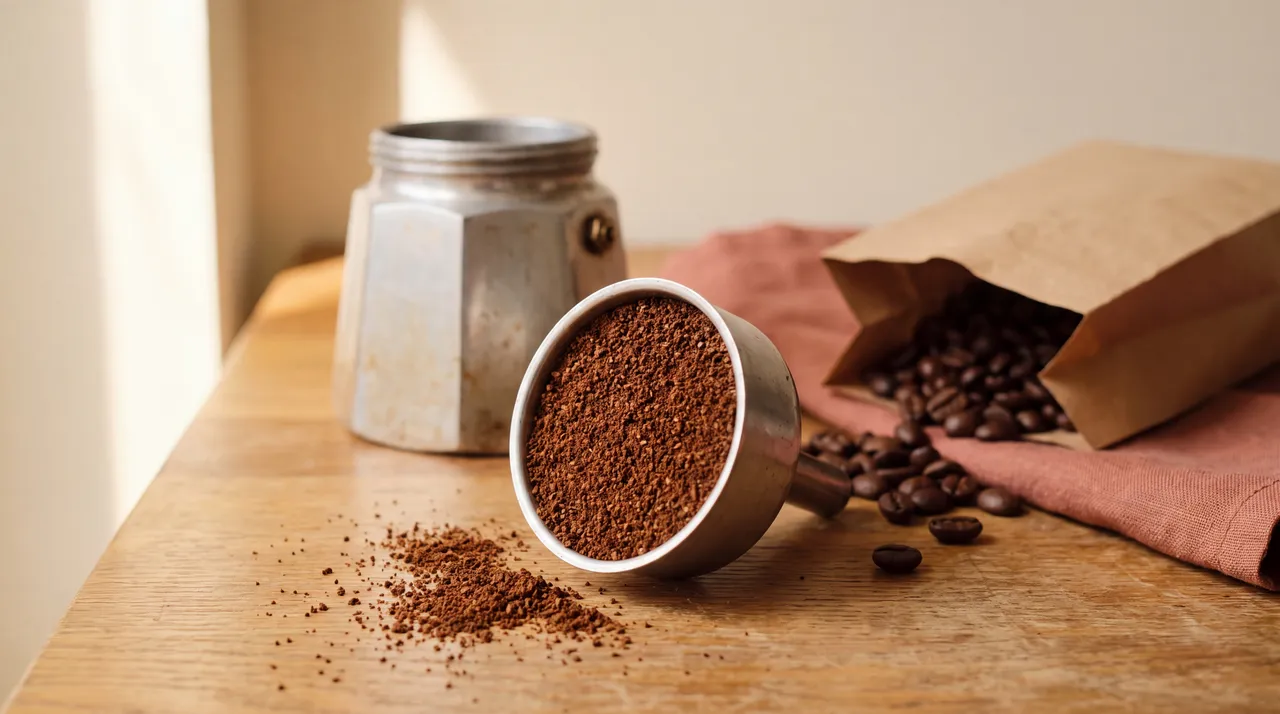
Grind-wise, for a Moka pot coffee, you need a medium or medium-fine grind. It needs to be finer than it would be for a drip coffee or percolator but not as fine as you’d use for espresso.
A moka pot gives you more room than espresso does, but don’t read that as “grind size doesn’t matter.” Go too coarse and the water races through, leaving you a thin, sour cup.
Go too fine and you choke the filter, which is the most common cause of a sputtering moka pot.
Aim for table salt and adjust from there.
Grind is only half of it, though. How much coffee you put in the basket matters just as much, and our moka pot ratio and grind size guide shows how to find the right dose for your pot.
Grinding your own whole coffee beans for your Moka pot is the best way to ensure you get the perfect grind. Buying whole beans means experimenting with different coffee grinds to perfect your coffee flavor.
You can work to get that rich, flavorsome, and concentrated coffee that every coffee enthusiast seeks when they use whole beans in their coffee grinder.
It would be best if you got a good grind to ensure optimal extraction. If it’s too coarse, your coffee risks being watery, weak, and acidic.
If you grind it too finely, you might end up with a brew that tastes burnt and bitter - and not a bitter cocoa aroma, just unpleasantly bitter.
Coffee Origin
The origin of coffee only matters a little with Moka pots. However, these coffee makers originated in Italy, so Italian coffee is always a good idea.
Italian roasters build their blends around the moka pot because that’s what most of their customers are brewing with at home.
As such, the most sensible thing when choosing coffee for Moka pots is to go for a brand like illy or Lavazza.
These brands will no doubt have tested their coffees in a Moka pot or stovetop espresso maker.
Let’s look at the 5 best coffee for Moka pot brewing.
5 Best Coffee for Moka Pot Brews
Here are five options to give you delicious coffee with your Moka pot.
illy Ground Moka Coffee, Classico (Best Overall)
Best for: anyone who wants to buy one tin, put it in the pot, and be done thinking about it.
- Sold as a dedicated moka grind, not the drip or espresso version
- 100% Arabica blend of nine origins, medium roast
- Pressurised tin keeps it fresh until you open it
Pros
- The grind is already right, which removes the most common failure point
- Low acidity and a consistent cup batch to batch
- Widely stocked, so it is easy to reorder
Cons
- Only 8.8 oz a tin, so the cost per cup is high
- Medium roast is tamer than some moka drinkers want
- Pre-ground means it stales faster once the tin is open
Here’s the thing that makes this the pick, and it’s easy to miss when you’re shopping. illy sells Classico in three separate grinds: espresso, drip, and moka.
They’re different products with different ASINs.
The moka version is ground specifically for stovetop pots, which means the single most common reason moka coffee tastes bad is handled before the tin reaches you.
Check the label says Moka before you buy. The drip version of the same blend is ground coarser and will give you a thinner, more sour cup.
The blend itself is 100% Arabica, nine origins, medium roast, founded on a recipe the company has been refining since Francesco Illy started it in 1933. It’s packed in a pressurised tin that keeps oxygen out until you open it.
What’s annoying about it: 8.8 oz doesn’t go far, and per cup this is one of the more expensive ways to fill a moka pot. Once the tin is open you’re on a clock, because pre-ground coffee stales quickly.
And the medium roast is deliberately balanced, so if you’re chasing something darker and heavier, look further down this list.
Lavazza Espresso Italiano (Best Value)
Best for: the everyday tin you keep restocking without thinking about the price.
- 100% Arabica from Central and South America
- Medium roast ground fine for espresso
- Sold in tins and larger bags, so cost per cup drops if you buy up
Pros
- Cheapest way to get a proper Italian blend in the pot
- Balanced and full-bodied without turning harsh
- Easy to find in supermarkets, not just online
Cons
- Espresso grind is finer than ideal, so never tamp it
- Less aromatic than Qualità Oro
- The 8 oz tin runs out fast
Lavazza was founded by Luigi Lavazza in Turin in 1895 and the business is still family run, four generations in. Espresso Italiano is their workhorse blend, 100% Arabica from Central and South America, medium roast, smooth and full-bodied without going harsh.
It ships as a fine espresso grind, which is slightly finer than a moka pot ideally wants. That’s fixable and it matters: fill the basket loosely and level it off with your finger rather than pressing it down. Tamp it and you’ll choke the filter and get a sputtering pot instead of a brew.
What’s annoying about it: the 8 oz tin empties fast, and it’s less aromatic than Qualità Oro if you put them side by side. The grind is a real compromise rather than a rounding error, so if you own a grinder, buy the whole bean version instead and set it a notch coarser.
Lavazza Qualità Oro (Best Cup)
Best for: the person who has tasted the cheap Italian tins and wants a noticeably better cup for a few dollars more.
- Blend of six Arabica varieties from Central and South America
- Medium roast, sweet and full-bodied with low bitterness
- Lavazza markets it directly as a moka pot coffee
Pros
- More aromatic and sweeter than the standard supermarket Italian blends
- Also sold as whole bean if you would rather grind it yourself
- Consistent, and the tin holds freshness well
Cons
- Costs more than Espresso Italiano for a similar size tin
- Ground for espresso, so it runs slightly fine for a moka pot
- Not a dark roast, so it will not satisfy anyone chasing pure intensity
Qualità Oro, which translates as Gold Quality, is not a recent premium spin-off. It’s the first blend Lavazza ever created, launched in 1956 and unchanged in character since.
Six Arabica varieties from Central and South America, medium roast, sweet and full-bodied with very little bitterness.
The strongest argument for it isn’t mine. Lavazza’s own product page sells this blend specifically as ground coffee for the moka pot.
When the roaster tells you what their coffee is for, that’s worth more than most reviews.
You can buy it pre-ground or as whole bean, so if you own a grinder you can dial it in yourself.
What’s annoying about it: it costs more than Espresso Italiano for the same size tin. The pre-ground version is still cut for espresso, so the same loose-fill, no-tamping rule applies.
And it’s a medium roast at heart, so if what you actually want is something dark and punishing, this isn’t it.
Death Wish Coffee Dark Roast (Strongest)
Best for: people who own a grinder and want the cup to hit like a brick.
- Arabica and Robusta blend, dark roast, low acidity
- USDA organic and Fair Trade certified
- 16 oz bag, double the size of the Italian tins
Pros
- Genuinely intense, with dark chocolate and black cherry behind the strength
- Robusta content survives the moka pot's hard extraction
- Best value per ounce on this list
Cons
- Ground for drip and French press, so it is too coarse for a moka pot
- Buy the whole bean version instead and grind it yourself
- Too much for anyone who wants nuance in the cup
Buy the whole bean, not the ground. I’ll put that first because it’s the whole story with this one.
Death Wish’s ground bag is cut for drip and French press, which is too coarse for a moka pot.
Brew it as it comes and the water rushes through the bed, and you get a weak, sour cup out of the strongest coffee on the list.
Grind it yourself to table salt and it’s a different drink entirely.
Mike Brown started the company in Saratoga Springs in 2012 chasing the world’s strongest coffee, and the caffeine comes from the blend rather than any additive. It’s Arabica cut with Robusta, and Robusta carries roughly twice the caffeine of Arabica along with a heavier, rubbery body.
That body is why it stands up to a moka pot’s hard extraction when a delicate coffee would fall apart.
Dark roast, low acidity, with baker’s chocolate and black cherry underneath the intensity. USDA organic and Fair Trade certified.
At 16 oz it’s also the best value per ounce here, double the Italian tins.
What’s annoying about it: the grind, as covered. It’s one-note, so don’t come looking for nuance.
Dark oily roasts like this one also leave more residue in the filter plate than a medium roast does, so budget for cleaning your moka pot more often than you would otherwise.
And a moka pot concentrates it far more than a drip machine does, so if you already find Death Wish strong in a drip maker, expect the moka version to be genuinely too much.
Volcanica Sulawesi Celebes Kalossi (Best Single Origin)
Best for: anyone bored of Italian blends who wants a single origin that won’t turn sour in the pot.
- Single origin from the Toraja highlands of Sulawesi, Indonesia
- Wet-hulled, giving the heavy body and earthy character
- Roasted to order in Atlanta, so it arrives fresh
Pros
- Low acidity, which is why it works here when most single origins do not
- Caramel, chocolate and earth rather than the usual Italian blend profile
- Fresh roast date, unlike a tin that has sat in a warehouse
Cons
- Costs noticeably more than the Italian blends
- The ground version is a standard grind, not a moka grind
- Earthy, wet-hulled character is not to everyone's taste
This is the outlier here and it’s worth being straight about that. The other four are Italian-style blends built for exactly this job.
Sulawesi is a single origin that happens to suit it, and the reason it suits it is acidity.
Most single origins are too bright for a moka pot. The pot brews hot, extraction is aggressive, and a bright Ethiopian or Kenyan that tastes like citrus in a pour over comes out tasting like a sour mistake on the stove.
Sulawesi is the opposite: heavy-bodied, low-acid, with caramel, chocolate and a wet-earth character.
That character comes from the processing. Sulawesi coffee is wet-hulled, meaning the beans are hulled while their moisture content is still high.
It’s an Indonesian method and it’s the reason Sumatra and Sulawesi taste like nothing else.
The trees grow in the Toraja highlands, some of them well over 200 years old.
Volcanica roasts to order in Atlanta, so this arrives with a real roast date on it rather than having sat in a warehouse. If you’ve only ever used tins, the difference fresh coffee makes is the other half of this whole conversation.
What’s annoying about it: it costs noticeably more than the Italian blends. The ground version is Volcanica’s standard grind rather than a moka grind, so if you can, buy it whole bean and grind to table salt.
And wet-hulled coffee is genuinely divisive. If earthy and musty doesn’t sound appealing to you, it won’t grow on you.
Final Thoughts on The Best Coffee for Moka Pot Brews
Moka pots come up constantly in “best brewing method” arguments, and for good reason. They’re cheap, they last decades, and they make a genuinely strong cup with no machine on your counter.
Getting the best coffee for moka pots matters as it can make the difference between a great coffee and an average coffee.
When it comes to choosing, it doesn’t matter if you prefer pre-ground coffee or coffee beans sold whole.
With pre-ground coffee, make sure you choose a medium to fine grind and a medium roast to dark roast.
Dark roast works well here because a moka pot brews hot and extracts hard. Low-acid, well-roasted beans stay smooth under that treatment.
Bright, acidic light roasts tend to go sour.
Our guide to the 5 best coffee for moka pots has something for all tastes; we’ve covered well-known brands, less well-known brands, whole bean coffee, pre-ground coffee, blends of coffee beans, and single-origin coffee.
All that’s left to do is try them out.