Moka pot grind size is medium-fine: a step coarser than espresso, a step finer than drip. Fill the basket level without tamping, and fill the water to just below the valve. Do that and the pot sets the moka pot ratio for you.
Lavazza’s 3-cup recipe, for example, works out to 1:6: 20 g of coffee to 120 ml (about 4 oz) of water. The tables below cover grind, pot sizes, grinder settings and what to change when it tastes wrong.
I brew on a Nespresso Vertuo Up, not a moka pot, and I’m not going to pretend otherwise. This page is built from Bialetti’s own instructions and specs, the grinder makers’ manuals and Lavazza’s moka recipe.
Moka pot grind size
Bialetti says moka coffee needs a medium grain, coarser than the blend for espresso. Lavazza calls the same thing medium-fine, about like table salt. In practice it sits between the two settings you probably already know.
| Grind | Looks like | What happens in the pot | How it tastes |
|---|---|---|---|
| Too fine (espresso or finer) | Flour or powdered sugar | Slow, spluttering flow, sludge in the cup | Bitter and harsh |
| Right (medium-fine) | Table salt | Steady dark stream after 2 to 3 minutes | Strong and rounded |
| Too coarse (drip or French press) | Kosher salt or coarser | Rushes up fast and pale | Sour and thin |
If your coffee tastes wrong, change the grind before you change anything else.
A moka pot runs on steam pressure built up in the base, with no pump behind it. Grind too fine and the water can’t push through the coffee bed, so it stalls, spits and over-extracts. Bialetti’s own manuals say to never use a fine grind.
Bialetti also gives you a free test. Swirl your cup after pouring. If there’s a layer of powder on the bottom, the grind was too fine.
Buying pre-ground? Look for bags labeled for moka. Our pick of the best coffee for moka pots covers five that hold up to stovetop brewing, ground and whole bean.
If you grind your own, a burr grinder is the one upgrade that fixes most moka pot problems. Blade grinders make a mix of dust and chunks, and the dust is what chokes the basket.
- 40 grind settings, from espresso (8) to French press (28) in Baratza's own chart
- Conical steel burrs give an even grind with less dust than a blade grinder
- Simple on/off switch and pulse button on the front
Pros
- Covers moka pot, drip and French press from one dial
- Even particles keep the moka basket from choking
- Parts are sold separately, so it can be repaired
Cons
- Not built for fine espresso dialing
- No timer or dose control
- Louder than a hand grinder
How much coffee in a moka pot, by size
A moka pot “cup” is a small espresso cup of about 1.5 oz, going by Bialetti’s own capacities. So a 6-cup pot makes about 9 oz of coffee: six espresso-size cups, or roughly one big mug.
That catches out a lot of American buyers. Here’s what each Bialetti Moka Express size makes, using Bialetti’s published capacities.
| Pot size | Makes | 2 oz servings | Good for |
|---|---|---|---|
| 1-cup | 2 oz (60 ml) | 1 | One straight shot |
| 3-cup | 4.4 oz (130 ml) | 2 | One latte, or two straight |
| 6-cup | 9.1 oz (270 ml) | 4 to 5 | Two lattes |
| 9-cup | 14.2 oz (420 ml) | 7 | Three or four people |
| 12-cup | 22 oz (650 ml) | 11 | A table full of guests |
Your basket sets the dose
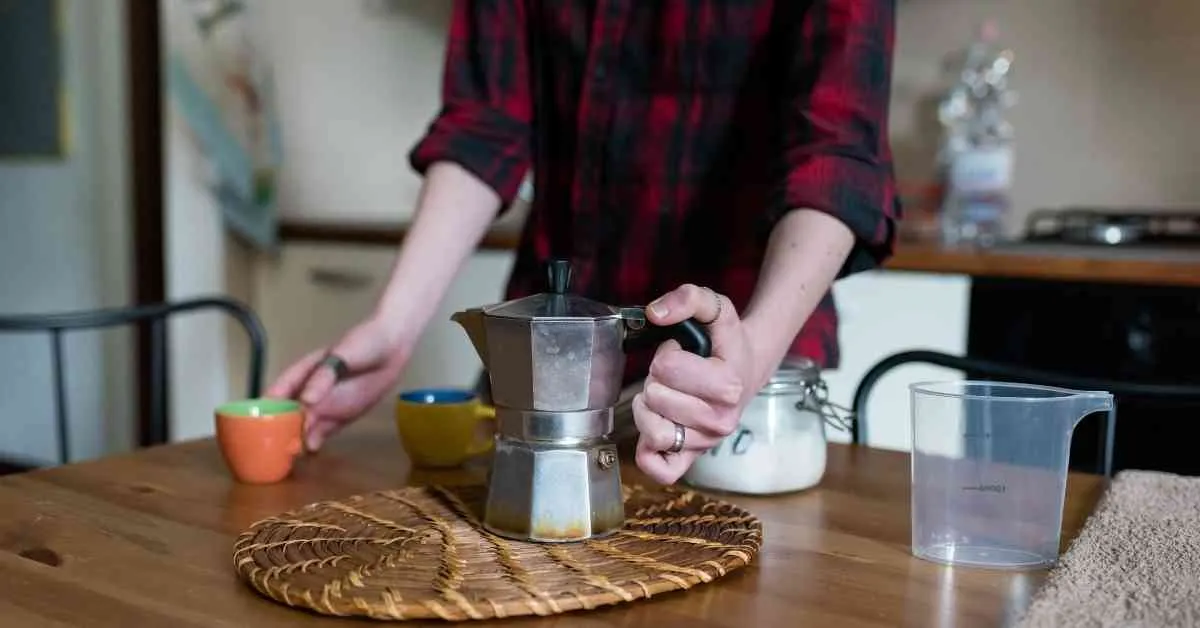
You don’t choose how much coffee goes in a moka pot. The basket does. Bialetti’s instruction is to fill the funnel to the edge, level it off, avoid a mound and never press it down.
Bialetti doesn’t publish how many grams each basket holds, and baskets vary between brands. That’s why every gram chart online gives different numbers for the same “6-cup” pot. Your own pot will tell you in two minutes:
- Put the empty basket on a kitchen scale and zero it.
- Fill it with your coffee to the rim and scrape it level with a knife.
- Read the grams. That’s your dose, every time, for that pot and that coffee.
- Zero the scale with the empty base on it, then fill with water to just below the valve. That’s your water.
- Divide the water by the coffee. That’s your moka pot ratio.
No scale? Fill the basket level and you’re already right. The basket did the measuring.
- Makes about 9 fl oz (270 ml) of concentrated coffee per brew
- Aluminum body with the patented Bialetti safety valve
- Works on gas and electric; induction only with Bialetti's adapter plate
Pros
- Strong enough to stand up to milk for lattes and cappuccinos
- Spent grounds knock out as a dry puck
- No glass to break, so it survives camping trips
Cons
- Not dishwasher safe; hand wash only
- Not induction ready without the separate adapter
- A 6-cup makes 6 small espresso-size cups, not 6 mugs
Moka pot grind settings for Baratza and Breville grinders
Neither the Baratza Encore nor the Breville Smart Grinder Pro manual lists a moka setting. Both list espresso and the method just coarser than it, and a moka pot sits between the two. These are starting points from the manufacturer settings, not finished answers.
| Grinder | Espresso setting | Next method up | Start moka at |
|---|---|---|---|
| Baratza Encore | 8 | 12 (AeroPress), 15 (V60) | 12 |
| Breville Smart Grinder Pro | 1 to 30 | 31 to 48 (drip) | 30 |
Sources: Baratza’s Encore manual and Breville’s BCG820 instruction book.
From there, move one step at a time. Coffee rushes up pale and tastes sour: go one step finer. It spits, stalls or tastes bitter: go one step coarser.
If your settings seem off from day one, the burrs may need zeroing. Here’s how to calibrate a coffee grinder.
Moka pot ratio: why the numbers online don’t agree
There’s no single moka pot ratio, because the pot sets it and nobody measures the same thing. You’ll see anything from 1:6 to 1:10 quoted. Three things cause the spread:
- Water in vs coffee out. Some guides divide by the water you pour into the base. Others divide by the coffee that comes out the top. Some water always stays behind in the base below the funnel tube, so the “coffee out” ratio comes out stronger on paper.
- Different baskets. Two “3-cup” pots from different brands don’t hold the same grams.
- Different grinds. A finer grind packs more grams into the same basket.
For scale, the Specialty Coffee Association tests home drip brewers at 55 g of coffee per 1 kg of water, about 1:18. Lavazza’s moka recipe runs at 1:6.
A moka pot uses about three times as much coffee per ounce of water as a drip machine. That’s why it tastes so strong, and why it stands up to milk.
Owner threads on r/Coffee keep landing in the same place: fill the basket, then fix the taste with grind and heat. James Hoffmann’s widely shared moka method works the same way. He keeps the basket full and changes the water temperature and heat instead.
How to make moka pot coffee stronger or weaker
- Weaker: brew as normal, then add hot water in the cup. That’s an Americano, and it beats underfilling the basket every time.
- Stronger: go one step finer on the grinder, or switch to a darker roast.
- Don’t underfill the basket. Bialetti says to fill it to the edge. Gaps let the water rush through and the coffee comes out thin and sour.
- Don’t fill water above the valve. Bialetti warns it makes the coffee watery.
- Watch the heat. Bialetti says low heat. Lavazza says medium-low on the smallest burner. Lavazza also starts with water just off the boil, around 195 to 205°F (90 to 96°C), which cuts the time the coffee sits on the stove.
- Stop at the gurgle. When the stream starts to sputter, take the pot off and run the base under cold water for 10 to 15 seconds, as Lavazza’s recipe does.
For the full step-by-step, see how to use a moka pot.
Moka pot ratio for lattes and Americanos
Moka coffee is strong enough to carry milk, which is what most people buy one for. These are starting points. Adjust to taste.
| Drink | Moka coffee | Add | Cup size |
|---|---|---|---|
| Latte | 2 oz | 6 oz steamed milk | 8 oz |
| Flat white | 2 oz | 4 oz steamed milk | 6 oz |
| Cappuccino | 2 oz | 2 oz hot milk, 2 oz foam | 6 oz |
| Americano | 2 oz | 4 to 6 oz hot water | 6 to 8 oz |
| Iced latte | 2 oz | 6 oz cold milk, over ice | 12 oz glass |
A 3-cup pot makes enough for one strong latte. A 6-cup makes two.
The milk side is where my own kitchen comes in. My red Aeroccino 3 heats up to 8 oz (240 ml) of milk or froths 4 oz (120 ml), which is the right amount for one latte off a 3-cup pot. Any frother or a saucepan and whisk does the same job.
If you’re wondering whether milk drinks justify a real machine, here’s how a moka pot compares with an espresso machine.
Moka pot troubleshooting by taste
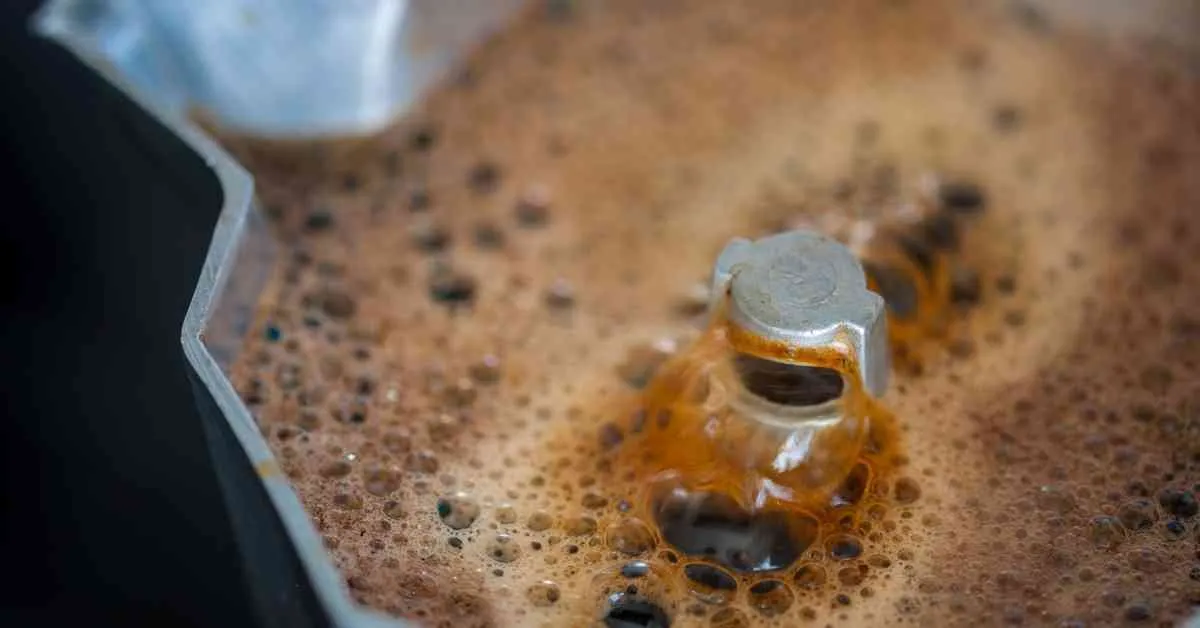
Most bad moka coffee comes down to grind, heat or how you filled it. Find your problem, make the one change, and brew again.
| Problem | Likely cause | Fix |
|---|---|---|
| Bitter or burnt | Grind too fine, heat too high, or left on after the gurgle | One step coarser, lower heat, pull it at the first sputter |
| Sour and thin | Grind too coarse or basket underfilled | One step finer, fill the basket to the rim |
| Powder in the bottom of the cup | Grind too fine | One step coarser |
| Spits and sputters early | Heat too high or grind too fine | Lower the heat first, then go coarser |
| Stalls, nothing comes up | Coffee pressed down or ground too fine | Don’t tamp, go coarser |
| Watery | Water filled above the valve | Fill to just below the valve |
Sputtering that won’t stop has a few other causes, from a worn gasket to the wrong size burner. Here’s how to fix a sputtering moka pot.
Moka pot grind size and ratio FAQs
Is moka pot grind the same as espresso grind?
No. Bialetti says moka coffee should be coarser than espresso. An espresso grind packs too tightly for the low steam pressure in a moka pot, so it brews slowly and tastes bitter.
What size moka pot do I need for 2 people?
A 3-cup pot makes about 4.4 oz, enough for two straight cups or one latte. If you both drink lattes, get the 6-cup, which makes about 9 oz.
Do I need a moka pot ratio calculator?
No. Your basket is the calculator. Fill it level, fill the water to just below the valve, and the ratio takes care of itself. Weigh it once if you want the number.