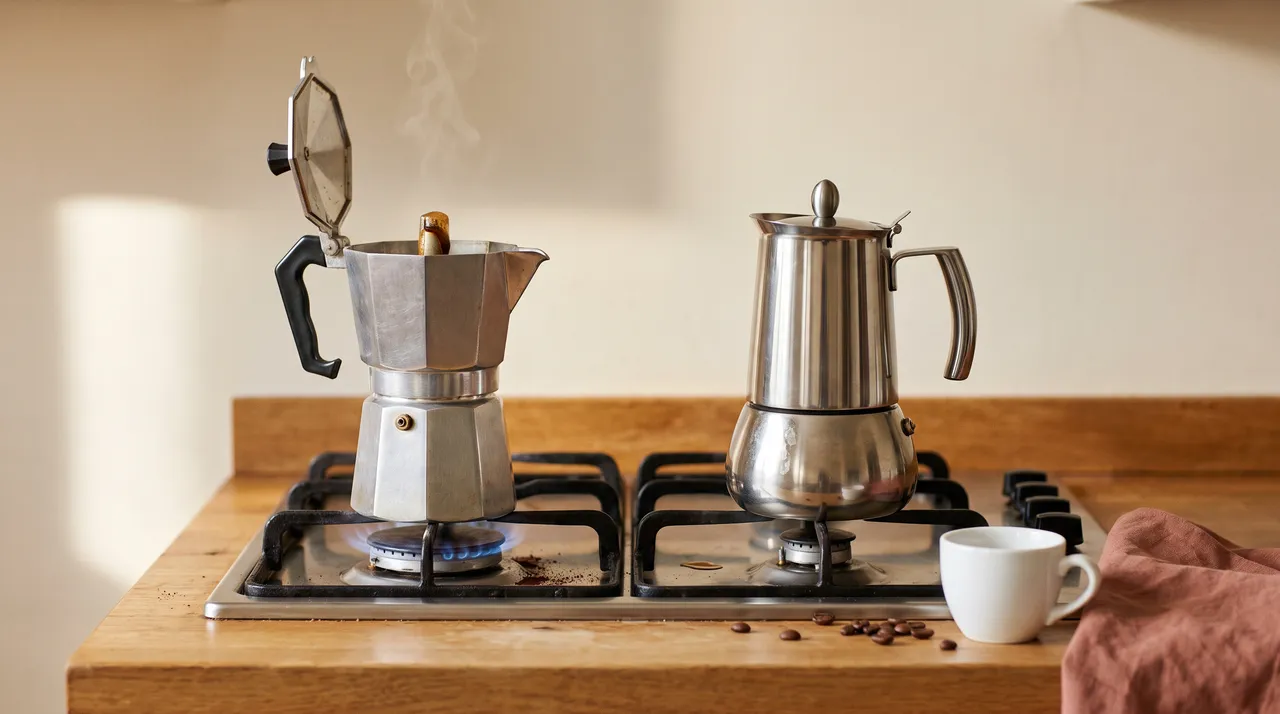
The best stovetop espresso maker for most kitchens is the Bialetti Moka Express, at about $50 for the 6-cup. Cook on induction? Buy the Bialetti Venus instead. Both brew strong, espresso-style coffee that carries milk well.
I brew on a Nespresso Vertuo Up, not a moka pot, and I haven’t had these six on my stove. This page is built from the makers’ spec sheets and manuals, a peer-reviewed study on aluminum, and what owners report in the long-running threads.
The comparison table comes first, then sizes, then each pick and what’s annoying about it.
- Best OverallCheck Price
The original aluminum stovetop brewer, and the one every other moka pot copies
- Best Stainless SteelCheck Price
An 18/10 stainless steel moka pot that works on every hob type
- Best for InductionCheck Price
Bialetti Moka Induction, 6-Cup
The Moka Express design with a steel outer shell, so it heats on induction
- Best ValueCheck Price
An aluminum moka pot that brews 15.2 oz, enough for three people, for about the price of a 6-cup Bialetti
- Best for CremaCheck Price
Bialetti's weighted-valve moka pot, sold as the one that makes crema
- Best SplurgeCheck Price
Richard Sapper's 1978 steel moka pot, in MoMA's collection and fine on induction
The best moka pots compared
| Pot | Material | Induction | Brews | Amazon price |
|---|---|---|---|---|
| Bialetti Moka Express, 6-cup | Aluminum | No, plate needed | 9.1 oz | $49.98 |
| Bialetti Venus, 6-cup | 18/10 stainless steel | Yes | 7.9 oz | $45.24 on sale |
| Bialetti Moka Induction, 6-cup | Aluminum inside, steel outside | Yes | About 9 oz | $54.99 |
| Grosche Milano, 9-cup | Aluminum | No | 15.2 oz | $54.99 |
| Bialetti Brikka, 4-cup | Aluminum | No | 5.7 oz | $79.95 |
| Alessi 9090, 6-cup | 18/10 stainless steel | Yes | 10.1 oz | $146.54 |
Prices checked on Amazon US on 15 October 2026. Brew volumes come from each maker’s listing for the size in the table.
All six work on gas and electric stoves. Aluminum pots don’t work on induction without an adapter plate. If that’s your stove, here’s the full breakdown on using a moka pot on an induction stove.
Which one should you buy? Start here:
- Gas or electric, one or two people: Moka Express, 6-cup.
- Induction, or you’d rather skip aluminum: Venus, 6-cup.
- Induction, and you want Express-style coffee: Moka Induction.
- Three or more people on a budget: Grosche Milano, 9-cup.
- You care about foam more than volume: Brikka.
- It’s a gift, or it lives on display: Alessi 9090.
What size moka pot should I get?
A moka pot “cup” is an espresso cup, not a mug. That catches out a lot of first-time buyers.
Here’s what each size of the Moka Express makes, from Bialetti’s published capacities. Other brands’ 6-cup pots land within about an ounce of the Express.
| Size | Brews | Good for |
|---|---|---|
| 1-cup | 2 oz (60 ml) | One straight shot |
| 3-cup | 4.4 oz (130 ml) | One latte, or two straight |
| 6-cup | 9.1 oz (270 ml) | Two lattes, or one big mug |
| 9-cup | 14.2 oz (420 ml) | Three or four people |
| 12-cup | 22 oz (650 ml) | A table full of guests |
A moka “cup” is about 1.5 oz, so a 6-cup pot makes one big mug or two lattes.
Most people should buy the 6-cup. A moka pot only brews well full, so you can’t make half a pot in a big one.
The basket sets the dose. You fill it level, every time, which is why sizing down for “just me today” doesn’t work. Here’s how much coffee each size takes, and our picks of the best coffee for moka pots if you’d rather skip grinding.
Best overall: Bialetti Moka Express
- Makes about 9 fl oz (270 ml) of concentrated coffee per brew
- Aluminum body with the patented Bialetti safety valve
- Works on gas and electric; induction only with Bialetti's adapter plate
Pros
- Strong enough to stand up to milk for lattes and cappuccinos
- Spent grounds knock out as a dry puck
- No glass to break, so it survives camping trips
Cons
- Not dishwasher safe; hand wash only
- Not induction ready without the separate adapter
- A 6-cup makes 6 small espresso-size cups, not 6 mugs
Buy this if you cook on gas or electric and want the pot every other moka pot copies.
Bialetti launched it in 1933, and the octagonal aluminum body hasn’t changed much since. The flat sides give you something to grip when you screw it together hot.
The 6-cup makes 9.1 oz. Bialetti sells it in 1, 3, 6, 9, 12 and 18-cup sizes, so whatever your household drinks, there’s a size for it.
The real reason it wins is parts. Bialetti sells replacement gaskets and filter plates for the Moka Express, and they’re widely stocked. When the gasket wears out, you replace a cheap ring, not the pot.
Bialetti says to rinse it with warm water after each use. No soap, no dishwasher.
What’s annoying about it: it’s aluminum, so it won’t heat on induction without a plate. And it needs a few throwaway brews to season before the coffee tastes right.
Best stainless steel moka pot: Bialetti Venus
- Makes about 7.9 fl oz per brew
- 18/10 stainless steel throughout, no aluminum
- Works on gas, electric and induction
Pros
- Nothing to season
- No aluminum touching your coffee
- Cheaper than the 6-cup Moka Induction at Bialetti's list prices
Cons
- Makes less coffee than the 6-cup Moka Induction
- Rinse only, no detergent or dishwasher, despite being steel
- The 2-cup Venus is not induction compatible, so don't size down
Buy this if you’re done with aluminum or you cook on induction.
The Venus is 18/10 stainless steel all the way through, with a thermoplastic handle. Bialetti lists it for gas, electric and induction. There’s no aluminum to season.
The 6-cup makes 7.9 oz, a little less than the Moka Express. Bialetti’s US store sells it in 4, 6 and 10-cup sizes.
Watch for one catch if you buy elsewhere. The 2-cup Venus isn’t induction compatible, so don’t size down to it for an induction cooktop.
What’s annoying about it: $45.24 is a sale price, about 35% off, so expect closer to $70 when the deal ends. It brews less than the Express. And even though it’s all steel, Bialetti still says no detergent and no dishwasher.
Best for induction with the classic look: Bialetti Moka Induction
- Makes about 9.1 fl oz of concentrated coffee per brew
- Bi-layer boiler: aluminum inside, stainless steel outside
- Works on gas, electric and induction with no adapter
Pros
- Brews like a Moka Express because the water still touches aluminum
- No adapter plate to store or burn yourself on
- Same 6-cup capacity as the Express it replaces
Cons
- Costs $25 more than a 6-cup Moka Express at Bialetti's list prices
- Aluminum interior still needs seasoning
- Rinse only, no detergent or dishwasher
Buy this if you like Moka Express coffee and cook on induction.
It brews in aluminum, the same as the Express, and wraps the base in steel so an induction cooktop can heat it. The 6-cup makes about 9 oz, and it comes in 2, 4 and 6-cup sizes.
Because the boiler is aluminum, you still season it before your first real brew. That’s the trade against the Venus.
What’s annoying about it: you’re paying about $5 more than the Express for a steel jacket. If you already own an Express, a plate under it costs less than a new pot.
Best value: Grosche Milano
- Brews about 15.2 fl oz per pot
- Aluminum body with a silicone gasket and a safety valve
- Works on gas, electric, glass-top and propane stoves; not induction
Pros
- More coffee per dollar than any other pick
- Soft-touch handle with a burn guard
- Sold in several colors and in 3, 6, 9 and 12-cup sizes
Cons
- Aluminum, so it won't work on induction
- Grosche says to replace the seal every 3 to 6 months
- Hand wash only; a dishwasher tarnishes it
Buy this if you want more coffee per dollar, or a color other than silver.
The Milano is aluminum with a silicone gasket and a soft-touch handle that has a burn guard where it meets the pot. Grosche lists it for gas, electric, glass-top and propane stoves.
The 9-cup on this page brews 15.2 oz for the same $54.99 as the 6-cup Moka Induction. It also comes in 3, 6 and 12-cup sizes.
Grosche’s own listing says to replace the silicone seal every 3 to 6 months. That’s more often than Bialetti suggests, so budget for spare seals.
What’s annoying about it: aluminum again, so no induction, and Grosche says so outright. Hand wash only, and a dishwasher will tarnish it.
Best for crema: Bialetti Brikka
- Brews about 5.7 fl oz
- Weighted valve on the spout
- Aluminum; gas, electric and propane stoves
Pros
- A layer of foam a standard moka pot doesn't give you
- Enough for two small lattes
- Also sold in a 2-cup size
Cons
- Highest price per ounce on the list
- Not induction compatible; Bialetti sells a separate Brikka Induction
- Still moka pressure, so it isn't espresso
Buy this if a layer of foam on top matters more to you than volume.
The Brikka has a weighted valve on the spout. Bialetti sells it as the moka pot that makes crema, the foam a standard moka pot doesn’t give you.
The 4-cup here brews about 5.7 oz. It also comes in a 2-cup. It’s aluminum and runs on gas, electric and propane stoves. Bialetti makes a separate Brikka Induction for induction cooktops.
Keep your expectations straight. The foam is real, but the Brikka still brews at moka pressure, so it isn’t espresso. Here’s why in moka pot vs espresso machine.
What’s annoying about it: $79.95 for 5.7 oz of coffee is the worst value on this list. You’re paying about $30 more than a 6-cup Moka Express for less coffee and a layer of foam.
Best splurge: Alessi 9090
- Brews about 10.1 fl oz (300 ml)
- 18/10 stainless steel with a magnetic base
- Opens with a lever clamp instead of screw threads
Pros
- Most coffee of any 6-cup pot on the list
- Works on gas, electric and induction
- Nothing to season
Cons
- Roughly three times the price of a Moka Express
- Amazon listings are often third-party sellers
- Spare parts are mostly ordered online from Alessi
Buy this if the pot lives on the stove and you want to look at it.
Richard Sapper designed the 9090 for Alessi in 1978, and it’s in the Museum of Modern Art’s design collection. It’s 18/10 stainless steel with a magnetic base, so it works on induction.
The 6-cup brews 10.1 oz (300 ml), the most of any 6-cup here. It also comes in 1, 3 and 10-cup sizes.
Instead of screwing together, it opens with a lever clamp. That makes it easier to close when the base is full of hot water.
One induction note from Alessi’s own product page: your cooktop has to switch on with a pan as small as 90 mm (about 3.5 inches) across. Check your cooktop manual for the minimum on your smallest element.
What’s annoying about it: $146.54 for a moka pot. It’s three times the price of the Express for coffee that won’t taste three times better. And on Amazon, check the seller, because the listing we checked was a third-party one.
Best moka pot for lattes
Most people buy a moka pot to make lattes at home. That changes which size you want more than which brand.
For two lattes, buy a 6-cup. The Moka Express 6-cup makes 9.1 oz, enough coffee for two milk drinks from one brew. For three people, the 9-cup Grosche at 15.2 oz does it in one go.
The 4-cup Brikka’s 5.7 oz stretches to two small lattes, but you’re paying extra for foam the milk will cover anyway.
The coffee is half the job. You still need hot, foamed milk, and a handheld wand or an electric frother both work.
Mine is a red Aeroccino 3 that sits next to my Vertuo. It heats and foams the milk in its own jug, so it doesn’t care what made the coffee.
Any pot on this list makes coffee strong enough to taste through the milk. That’s the moka pot’s whole advantage over drip coffee for lattes.
Aluminum vs stainless steel moka pot
| Aluminum | Stainless steel | |
|---|---|---|
| Induction | Only with a plate (or a steel-wrapped base) | Yes, if a magnet sticks to the base |
| What touches your coffee | Aluminum | Steel |
| Seasoning | Yes, toss the first few brews | No |
| Care | Rinse only, no dishwasher | Rinse only on Bialetti’s, check other brands’ manuals |
| Price on this list | $50 to $80 | $45 to $147 |
Most people asking this want to know one thing: is aluminum safe?
A 2017 German study tested aluminum and stainless steel moka pots brewing six times each. Stahl and colleagues found the aluminum pots released more aluminum than steel, and the first brew from a new pot carried the most.
The worst brew they measured came after a dishwasher run: 0.795 mg of aluminum per liter of coffee. At 3.17 liters a week, about 107 oz, that’s roughly 4% of the weekly limit for a 154 lb (70 kg) adult. EFSA sets that limit at 1 mg per kg of body weight a week.
A properly used aluminum moka pot adds a tiny share of your weekly aluminum limit. The authors called the exposure negligible.
Two habits keep it that way. Throw away the first few pots from a new aluminum pot, which is what seasoning does anyway. And keep it out of the dishwasher, which Bialetti warns against too.
If you’d rather not think about it at all, buy steel.
Is Bialetti the best moka pot brand?
For most people, yes. Mostly because of parts, not because the coffee is magic.
- Bialetti: the widest size range and the easiest gaskets and filter plates to find. Four of the six picks here.
- Alessi: steel, beautiful and expensive. Alessi sells its own spare parts, but you’ll be ordering them online, not picking them up at the store.
- Grosche: good value and plenty of colors. Spare seals are sold, and Grosche says you’ll need them often.
- Unbranded Amazon pots: cheap, and a gamble on two things that matter, the basket size and whether a replacement gasket will ever fit.
That’s why there’s no pick under $25 on this page. Owners of the cheapest aluminum pots report thin walls, small baskets and weak coffee.
What to check before you buy
- The basket. It sets your dose, and a small one brews weak coffee however you grind.
- The handle. It should stick out far enough to stay cool, with room for more than two fingers.
- The base. Wide bases sit steadier on gas grates. Small bases can fall under an induction element’s minimum.
- The gasket. Check you can buy a replacement for that exact model and size before you buy the pot.
- The induction marking. Look for it on the base, or try a fridge magnet. If the magnet slides off, it won’t heat.
Once it arrives, here’s how to use a moka pot without burning the coffee.
FAQs
Are moka pots worth it?
Yes, if you want strong coffee for lattes and don’t want to spend $150 or more on an espresso machine. A $50 pot keeps going as long as you replace the gasket. If you drink black coffee by the mug, a drip machine or French press suits you better.
Do moka pots make good espresso?
They make strong, espresso-style coffee, not true espresso. A moka pot brews with steam pressure, well short of what a pump machine pushes through the coffee. With milk, most people can’t tell the difference.
How much is a good moka pot?
$45 to $55 buys four of the six picks here, prices checked October 2026. Below about $25, owners report thin metal and weak coffee. Above $60, you’re mostly paying for steel or design.
Can you put a moka pot in the dishwasher?
No. Bialetti and Grosche both say hand wash, and Bialetti says rinse with water only, no detergent. On aluminum pots, the dishwasher also raised the aluminum in the next brew in the Stahl study.