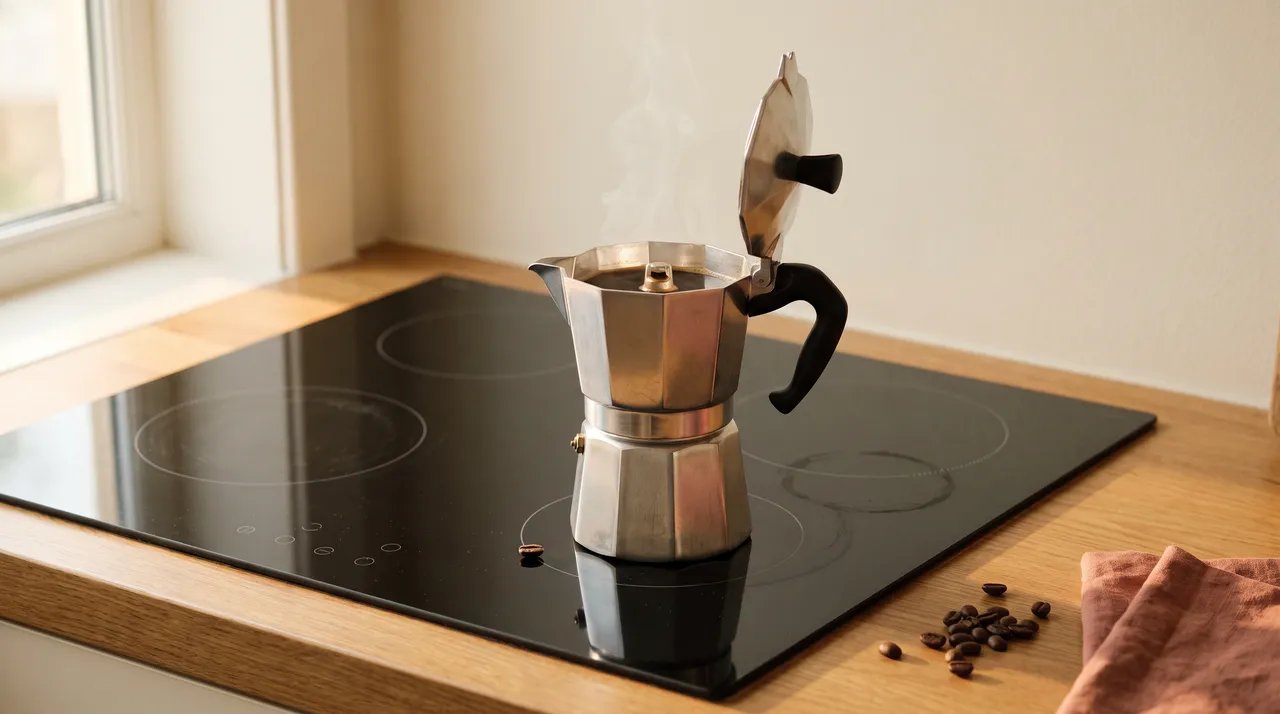
No. Put a classic aluminum moka pot on an induction stove and nothing happens, because induction only heats magnetic metal. You need an induction moka pot with a steel base, or a steel adapter plate under the pot you own.
If you brew every day, buy the pot. If you brew twice a month, buy the plate.
I make my daily coffee on a Nespresso Vertuo Up, not a moka pot, and I don’t cook on induction. I’m not going to pretend I’ve run these pots on a hob. What follows comes from Bialetti’s own specs and GE’s cooktop documentation.
Your options for a moka pot on an induction stove
| Option | Upfront cost | Keeps your pot | Downside | Verdict |
|---|---|---|---|---|
| Induction moka pot | $54.99 to $99.99 | No | You’re buying a new pot | Buy this if you brew daily |
| Adapter plate | $29.99 | Yes | Slower, and the plate stays hot | Fine for occasional use |
| Cast-iron or steel skillet | $0 if you own one | Yes | Uneven heat, wobbly | One emergency brew, then stop |
| Electric moka pot | Varies by model | No | Takes counter space | Only if you’d rather skip the stove |
Prices are Bialetti’s US list prices, checked on its induction shop page in October 2026. The pot range runs from the 2-cup Moka Induction at the bottom to the Brikka Induction at the top.
The plate costs about half what the cheapest induction pot does, but every brew on it takes longer.
In 6-cup terms: Bialetti sells the 6-cup Moka Express for $59.99 and the 6-cup Moka Induction for $84.99. If you already own the Express, the plate is a $29.99 fix. Replacing the pot is $84.99.
Best induction moka pots
| Pot | Build | Induction sizes | Dishwasher | List price |
|---|---|---|---|---|
| Bialetti Moka Induction | Aluminum inside, stainless steel outside | 2, 4, 6 cup | No, rinse only | $54.99 to $84.99 |
| Bialetti Venus | 18/10 stainless steel throughout | 4, 6, 10 cup | No, rinse only | $65.99 to $89.99 |
| Bialetti Brikka Induction | Aluminum and steel bi-layer boiler | 4 cup | No, rinse only | $99.99 |
All three come from Bialetti’s US store, prices checked October 2026.
“Induction-ready” doesn’t mean stainless steel. The Moka Induction keeps aluminum inside, where the water is, and adds a steel shell outside for the hob. So it brews like a Moka Express, and you still need to season the aluminum boiler before your first real brew.
The Venus is 18/10 stainless all the way through, so there’s no aluminum to season. Neither pot goes in the dishwasher. Bialetti says to rinse both with water and skip the detergent.
Bialetti Moka Induction, 6-cup
Buy it if you like Moka Express coffee and want the same cup on induction. The 6-cup makes about 9.1 oz. That’s six small espresso cups, not six mugs.
What’s annoying about it: it’s the expensive way to get a Moka Express. Bialetti charges $84.99 for the 6-cup, $25 more than the plain Express, and it’s still hand wash only.
- Makes about 9.1 fl oz of concentrated coffee per brew
- Bi-layer boiler: aluminum inside, stainless steel outside
- Works on gas, electric and induction with no adapter
Pros
- Brews like a Moka Express because the water still touches aluminum
- No adapter plate to store or burn yourself on
- Same 6-cup capacity as the Express it replaces
Cons
- Costs $25 more than a 6-cup Moka Express at Bialetti's list prices
- Aluminum interior still needs seasoning
- Rinse only, no detergent or dishwasher
Bialetti Venus, 6-cup
Buy it if you’re done with aluminum. It’s steel inside and out, there’s nothing to season, and it works on gas, electric and induction.
What’s annoying about it: the 6-cup makes 7.9 oz, less than the 9.1 oz you get from the 6-cup Moka Induction. And even though it’s all steel, Bialetti still says no dishwasher.
- Makes about 7.9 fl oz per brew
- 18/10 stainless steel throughout, no aluminum
- Works on gas, electric and induction
Pros
- Nothing to season
- No aluminum touching your coffee
- Cheaper than the 6-cup Moka Induction at Bialetti's list prices
Cons
- Makes less coffee than the 6-cup Moka Induction
- Rinse only, no detergent or dishwasher, despite being steel
- The 2-cup Venus is not induction compatible, so don't size down
Bialetti Brikka Induction
Bialetti sells the Brikka as the moka pot that makes crema, the foam layer a standard moka pot doesn’t give you. The induction version comes in one size, 4 cups (about 5.4 oz), for $99.99.
That’s the highest price on this list for the smallest brew. Buy it only if crema matters to you.
Induction adapter plates: the cheap fix
An adapter plate is a steel disc. It sits on the hob, the hob heats the disc, and the disc heats your pot from below.
Bialetti’s induction plate is 5.1 inches across and fits its 1- to 9-cup pots. It costs $29.99, goes in the dishwasher, and Bialetti says to heat it on medium.
- 5.1 inches across, food-grade stainless steel
- Fits Bialetti moka pots from 1 to 9 cups
- Sits on the hob and heats your pot from below
Pros
- Keeps the moka pot you already own
- Costs less than any induction moka pot
- Dishwasher safe
Cons
- Brews take longer than on a magnetic pot
- Stays hot after you lift the pot off
- One more thing to store
Whichever plate you buy, check four things:
- A magnet sticks to it.
- It’s at least as wide as the base of your pot.
- It sits flat on the glass with no wobble.
- You have an oven mitt ready, because you’ll be moving it hot.
The trade-off is speed. The hob heats the plate, then the plate heats the pot, so brews take longer than on a magnetic pot.
The plate also stays hot after you lift the pot off. That cancels induction’s one real safety perk: with no pan on it, an induction cooktop stays relatively cool to the touch.
The skillet trick works too. Stand the moka pot in a cast-iron or steel frying pan and heat the pan. It’s slow, it heats the pot unevenly, and you’re balancing a pressurized pot in a damn hot skillet. Use it once to check your pot still works, then buy a plate.
Why your induction moka pot won’t turn on
You bought a magnetic pot, set it on the hob, and the element won’t fire up. Two things cause that.
The base is too small. Induction elements need a minimum pan size before they switch on. GE says so in its cookware guidance and tells owners to check the manual for each element’s figure. Moka pots have small bases, so a 2- or 3-cup pot can fall under that minimum on a big element.
That size isn’t induction compatible. Some ranges only work on induction in certain sizes. Bialetti’s 2-cup Venus is the example: the larger sizes work, that one doesn’t. Bialetti’s US store only sells the Venus from 4 cups up, so this mostly bites if you buy one somewhere else.
Move the pot to your smallest element and look up your manual’s minimum pan size. If a small pot still won’t register, sit it on an adapter plate.
Why a regular moka pot won’t work on induction
An induction hob makes a magnetic field under the glass. Metal that contains iron heats itself in that field. Aluminum isn’t magnetic, so a classic moka pot sits there cold.
Cornell Cooperative Extension puts it plainly: glass, copper and aluminum generally won’t work unless the base includes iron, and most stainless steel works fine.
Stick a fridge magnet to the base of your pot. If it holds, the pot works on induction. If it slides off, it won’t.
How to brew a moka pot on an induction stove
The brew is the same as on gas. What changes is how fast the hob reacts.
- Fill the bottom chamber with water to just below the safety valve.
- Fill the basket with ground coffee, level it off, and don’t tamp it. A pre-ground moka coffee saves you the grind question; here are the best coffee for moka pots.
- Screw it together and set the hob to medium, the same advice Bialetti gives for its plate. Skip boost and maximum.
- Leave the lid open and watch the spout. Induction responds faster than gas, so turn it down as soon as coffee starts to flow.
- Pull it off the heat when you hear the gurgle.
Dials use different scales from brand to brand, so medium means the middle of yours.
If the pot spits and sputters, the heat’s too high. Here’s how to stop a moka pot sputtering. For the full method, including grind and ratio, see how to use a moka pot.
FAQs
Can I use an induction moka pot on a gas stove?
Yes. Bialetti lists the Moka Induction, the Venus and the Brikka Induction for gas, electric and induction.
Can an aluminum moka pot damage an induction stove?
No. The element doesn’t detect a magnetic pan, so it never heats. Nothing happens to the hob or the pot.
What’s the difference between the Moka Induction and the Moka Express?
The steel outer shell, and $25 at the 6-cup size. Both brew in aluminum. The Moka Induction adds steel outside so an induction hob can heat it.
Are stainless steel moka pots dishwasher safe?
Not Bialetti’s. It says to rinse the Venus with water only, no soap and no dishwasher. For other brands, check the manual.
If moka pot coffee is your daily habit, buy an induction pot: the Moka Induction if you like your Express, the Venus if you want steel. If the moka pot only comes out now and then, a $29.99 plate under the pot you already own does the job. On gas or electric, start with our full moka pot roundup.