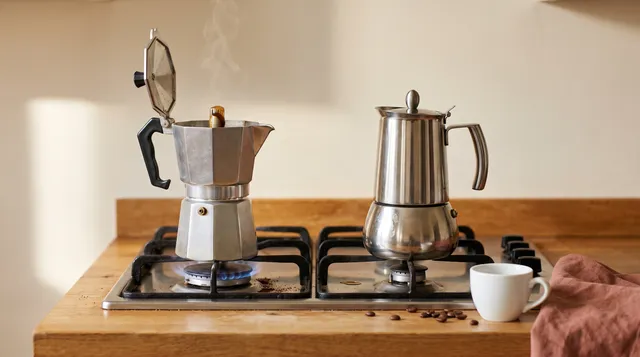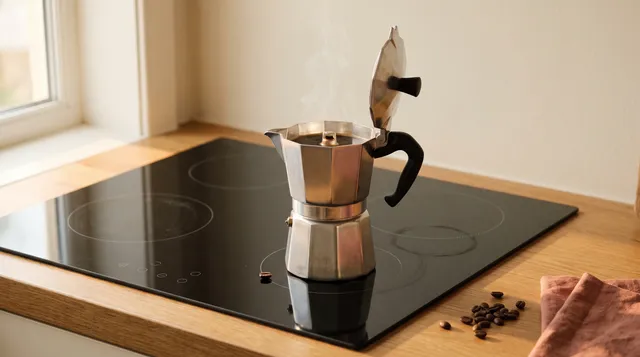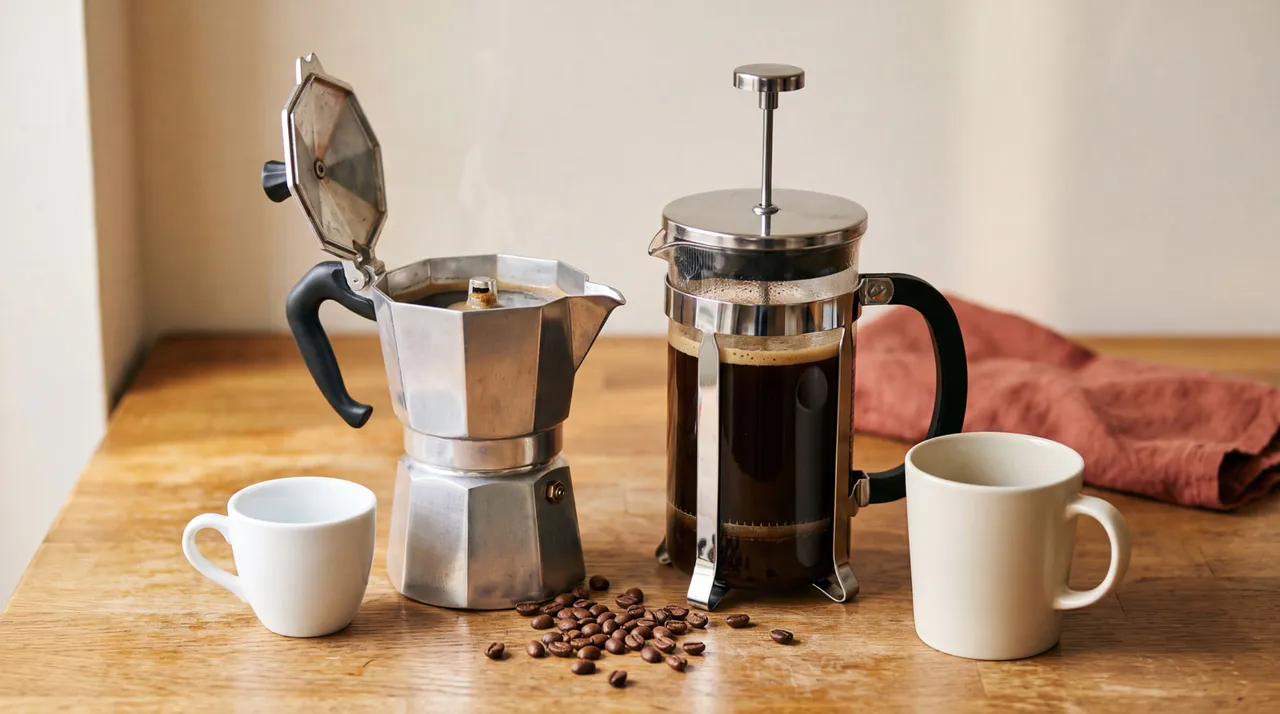
Buy a moka pot if you want small, strong, espresso-style coffee, mostly with milk. Buy a French press if you drink black coffee by the mug or brew for more than two people. That’s the whole French press vs moka pot decision for most kitchens.
A French press steeps coarse grounds in hot water for four minutes, then you push a mesh filter down. A moka pot, the Italian stovetop coffee maker, uses steam pressure to force water up through fine grounds. Different machines, different jobs.
Full disclosure: I own a French press and it lives in the back of a cupboard. For one cup it’s too much of a faff: boil the kettle, wait, stir, wait again, press, then scrape wet grounds out of a glass jug.
My daily coffee comes off a Nespresso Vertuo Up, and I don’t own a moka pot. So this page is built from Bialetti’s and Bodum’s own instructions, lab research that measured these brewers side by side, and a lot of owner threads.
Where I’m speaking from my own kitchen, I’ll say so.
French press vs moka pot at a glance
| Moka pot | French press | |
|---|---|---|
| How it brews | Steam pressure pushes water up through the coffee | Grounds steep in hot water, then a mesh filter separates them |
| Grind | Fine, about table salt | Coarse, about kosher salt |
| Dose | Fill the basket level, don’t tamp it | 1 rounded tablespoon per 4 oz of water |
| Brew time | 3 to 6 minutes on the stove | At least 4 minutes of steeping, plus kettle time |
| What you get | About 1.5 oz per “cup” (a 6-cup Bialetti makes about 9 oz) | Mug-sized servings (a 34 oz press makes about 8 x 4 oz) |
| Strength | Concentrated, espresso-adjacent | Regular coffee strength, heavy body |
| Texture | Thick, some bitterness | Oily and full, fine sediment at the bottom |
| Best roasts | Medium to dark | Anything, including light |
| Heat source | Stove or camp fire | A kettle |
| Breakable? | No, aluminum or stainless | Glass carafes, yes |
| Cleanup | Knock out a dry puck, rinse | Scoop out wet grounds, wash the mesh |
| Best for | Lattes, cappuccinos, one or two people | Black coffee, groups, light roasts |
The moka numbers come from the manual for the 6-cup Bialetti Moka Express, and the French press numbers from Bodum’s Chambord instructions. A moka “cup” means a small espresso cup, not a mug. That trips up a lot of first-time buyers.
If you’ve already picked a side, these are the two I’d buy. They’re the originals everything else copies, and they’re the models the numbers on this page come from. For stainless and induction options, see our moka pot buying guide.
- Makes about 9 fl oz (270 ml) of concentrated coffee per brew
- Aluminum body with the patented Bialetti safety valve
- Works on gas and electric; induction only with Bialetti's adapter plate
Pros
- Strong enough to stand up to milk for lattes and cappuccinos
- Spent grounds knock out as a dry puck
- No glass to break, so it survives camping trips
Cons
- Not dishwasher safe; hand wash only
- Not induction ready without the separate adapter
- A 6-cup makes 6 small espresso-size cups, not 6 mugs
- 34 oz (1 liter) borosilicate glass carafe in a stainless steel frame
- Stainless mesh filter plunger
- Bodum's recipe: 1 rounded tablespoon of coarse coffee per 4 oz, steep at least 4 minutes
Pros
- Makes enough black coffee for three or four people in one go
- Handles light roasts well
- No stove needed, just a kettle
Cons
- Glass carafe breaks if you drop it
- Wet grounds are messier to clean out than a moka puck
- Mesh lets fine sediment through to the last sip
The Bialetti is also the answer to “French press vs Bialetti”: Bialetti is the brand, and the Moka Express is the moka pot most people picture when they hear the word.
Which is stronger: moka pot or French press?
Ounce for ounce, a moka pot makes the stronger coffee. Cup for cup, the gap mostly disappears, because a French press serving is several times bigger.
The best data here comes from a Swiss lab study that brewed nine methods side by side, including a Bialetti moka pot and a Bodum French press. Gloess and colleagues ranked caffeine per sip from espresso at the top (21 mg per 10 ml, about 62 mg per ounce) down through the moka pot, then the French press, with filter coffee lowest at 4.7 mg per 10 ml (about 14 mg per ounce). They also found a 4 oz French press cup carried about the same caffeine as an espresso.
| Method | Caffeine per ounce | Typical serving |
|---|---|---|
| Espresso | About 62 mg | 1 oz shot |
| Moka pot | Below espresso, above French press | About 1.5 oz per moka “cup” |
| French press | Below moka, above filter | 4 oz per Bodum “cup”, usually two or three to a mug |
| Drip / filter | About 14 mg | 8 to 12 oz mug |
The study published exact figures for espresso and filter only; the moka and French press values sit between them on its charts, in the order shown.
So when someone on a forum swears the moka pot is “way stronger”, they mean the taste and the concentration. When someone says French press has more caffeine, they’re usually comparing a full mug against a small moka pour. Both are right about different things.
For a sense of scale, the FDA puts a 12 oz brewed coffee at 113 to 247 mg of caffeine, and 400 mg a day as the level healthy adults generally stay under. A big French press mug gets you there faster than a moka pour.
Moka pot vs French press taste
The moka pot makes a dense, dark, slightly bitter cup. It’s often called stovetop espresso, and it tastes closer to espresso than to drip, though it isn’t espresso (more on that below).
It rewards medium and dark roasts. Light roasts tend to come out sour and thin, because the water passes through fast and hot.
If you’re shopping for beans, the best coffee for moka pots covers five bags that hold up.
The French press makes a heavier, rounder cup. Nothing paper-filters the oils out, so you get more body and a slightly silty last sip. It’s forgiving with beans: light roasts show off their fruit, dark roasts go chocolatey.
For black coffee, pick the French press. Moka coffee drunk straight is intense, and a lot of people end up diluting it with hot water, which makes it an Americano with extra steps.
Moka pot vs French press for lattes and milk drinks
For lattes, cappuccinos and anything with milk, the moka pot wins easily. A couple of ounces of concentrated coffee holds its own under a mug of steamed milk. French press coffee is already mug-strength, so milk just waters it down.
Be clear on what you’re getting, though. A moka pot is not an espresso machine.
In lab tests, a moka pot’s boiler peaked at only a few bar of pressure, and the water started moving through the grounds at around 158°F (70°C), well short of boiling. A pump espresso machine brews at around 9 bar.
That’s why moka coffee has little to no crema. If you want the full breakdown, here’s why a moka pot isn’t espresso.
For the milk itself, this part I can speak to. I froth mine with a red Aeroccino 3, and a frother like that doesn’t care what brewed the coffee underneath. Moka pot plus any decent frother gets you a proper latte for a lot less than an espresso machine.
Can a French press do milk drinks at all? Sort of.
Warm some milk, pour it into the empty press, and pump the plunger up and down until it foams. That works, but the coffee underneath is still the weak link.
Grind size for moka pot vs French press
Grind is where most bad cups come from, so get this right before blaming the brewer.
| Grind | Looks like | Too fine | Too coarse | |
|---|---|---|---|---|
| Moka pot | Fine to medium-fine | Table salt | Chokes the filter, sputters, tastes burnt | Watery, sour, runs through too fast |
| French press | Coarse | Kosher salt or breadcrumbs | Hard to press, muddy, bitter | Weak and flat |
Bialetti says to use espresso-ground coffee and fill the basket loosely without pressing it down. Bodum says to use only coarse ground coffee, because fine grounds clog the mesh.
If you buy pre-ground, look for bags labeled “for moka” or “espresso” for the moka pot, and “coarse” or “for French press” for the press. Using French press coffee in a moka pot gives you a weak, sour cup. Using moka coffee in a French press gives you sludge and a plunger that fights you all the way down.
For the dose on the French press side, the French press coffee ratio goes through it size by size.
How each one brews, step by step
This is where the “moka pot vs French press” choice gets practical. Both are simple. They just ask different things of you.
Moka pot (Bialetti’s instructions):
- Fill the bottom chamber with water to just below the safety valve.
- Fill the filter basket with fine ground coffee, level it off, and don’t press it down.
- Screw the top on tight and set it on low to medium heat. On gas, keep the flame under the pot, not up its sides.
- Coffee starts rising into the top chamber. It takes 3 to 6 minutes depending on size and heat.
- Take it off the heat as soon as the top is full and it starts to gurgle. Leave it on and it tastes burnt.
French press (Bodum’s instructions):
- Add 1 rounded tablespoon of coarse ground coffee per 4 oz of water.
- Pour in hot water that’s just off the boil, not boiling.
- Stir, put the lid on with the plunger pulled up.
- Steep for at least 4 minutes.
- Press the plunger down slowly and pour straight away. Coffee left sitting on the grounds keeps extracting and turns bitter.
The moka pot needs you standing at the stove for those few minutes. The French press needs a kettle and a timer, then you can walk away. For a full walkthrough with troubleshooting, read how to use a moka pot.
Cleanup, durability and camping
Cleanup is a big part of why my French press stays in the cupboard. Wet grounds cling to the glass and the mesh, and coffee grounds are bad news for a sink drain, so you end up scooping them into the trash.
The mesh filter also needs taking apart now and then to clear trapped grounds. None of it is hard. For one cup, it’s just more hassle than it’s worth.
The moka pot is easier. Let it cool, knock the grounds out as a mostly dry puck, rinse the three parts in warm water. Bialetti’s aluminum pots are hand wash only, since dishwasher detergent corrodes aluminum.
Durability goes the moka pot’s way too. It’s a lump of aluminum or stainless steel.
A glass French press breaks the first time it hits a tile floor. Stainless steel French presses exist and solve that.
Heat source matters. A moka pot needs a stove or a fire.
Aluminum pots like the Moka Express only work on induction with Bialetti’s adapter plate, so buy a stainless model with a magnetic base if you cook on induction. A French press only needs hot water, which makes it the better pick for an office or a hotel room with a kettle.
For camping, the moka pot is the safer bet unless you pack a stainless or plastic press. If you’d rather take a press, here are some camping French press picks built to survive a backpack.
Moka pot vs French press vs pour over and AeroPress
If you’re still shopping around, here’s how the four common manual brewers line up.
| Method | Body | Strength | Best for |
|---|---|---|---|
| Moka pot | Thick | Concentrated | Milk drinks, espresso-style coffee without a machine |
| French press | Heavy, oily | Mug strength | Black coffee, groups, low effort per cup of a big batch |
| Pour over | Light, clean | Mug strength | Tasting light roasts, one cup at a time |
| AeroPress | Medium | Adjustable, from concentrate to mug | Travel, one person, fast cleanup |
Pour over gives the cleanest cup of the four because the paper filter catches the oils and the fines. The AeroPress sits between the moka pot and the French press, and cleans up faster than either.
FAQs
Which is better, a moka pot or a French press?
Neither, in general. The moka pot is better for strong coffee and milk drinks for one or two people. The French press is better for black coffee and brewing for a group.
Is moka pot coffee the same as espresso?
No. It’s close in taste and strength, but a moka pot brews at a few bar of steam pressure against the roughly 9 bar of an espresso machine, so you get a slightly thinner body and little or no crema.
Can you use French press coffee in a moka pot?
You can, but it won’t taste good. French press coffee is ground coarse, so the water rushes through a moka pot’s basket and you get a weak, sour cup. Use a fine grind, about like table salt.
Is French press coffee bad for your cholesterol?
It can raise it if you drink a lot. Unfiltered coffee keeps two oils, cafestol and kahweol, that paper filters remove.
In one trial, people drinking 0.9 liters of French press coffee a day, about 30 oz, saw their LDL cholesterol rise, with the increase becoming significant after 12 weeks. If your cholesterol is already a concern, filtered coffee is the safer habit.
Should I get an aluminum or stainless steel moka pot?
Aluminum is lighter, cheaper and the classic choice, but it’s hand wash only and needs an adapter for induction. Stainless steel costs more, is easier to keep clean and works on induction if the base is magnetic.
The short version
Get the moka pot if you drink lattes or want strong coffee for one or two, and don’t mind standing by the stove for five minutes. Get the French press if you drink black coffee by the mug, brew for a group, or like light roasts. And if cleaning a French press for a single cup sounds like a pain, trust me, it is.