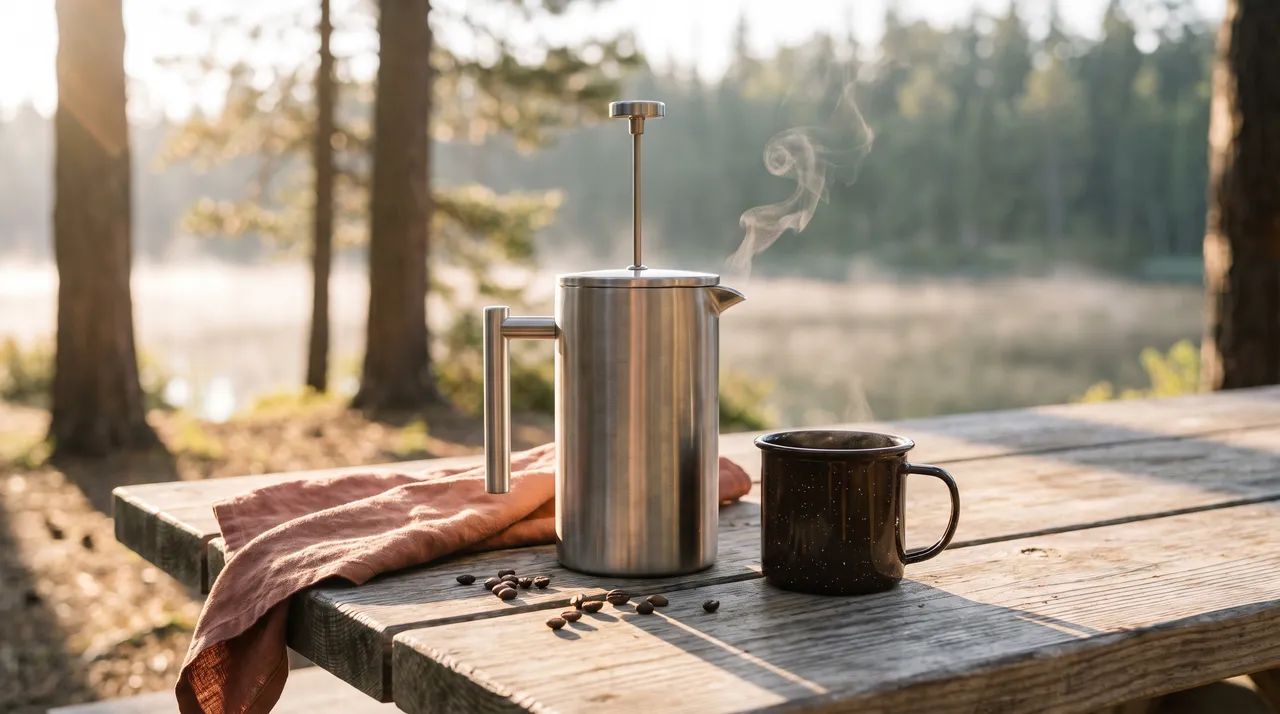
The best camping French press for most people is the Stanley All In One 32 oz: you boil the water in it, then brew in it.
Car camping with a group? Get the Stanley Stay-Hot 48 oz. Carrying it on your back? Get the ESPRO Go P0.
Full disclosure. I own exactly one French press, and it’s in a box in storage because I find them too much faff. My daily coffee comes out of a Nespresso Vertuo Up.
I have not carried these five presses into the woods, and I’m not going to pretend I have. What follows comes from the makers’ own specs and instructions, plus a lot of owner reviews about what breaks and what annoys people.
- Best OverallCheck Price
Stanley All In One French Press, 32 oz
One steel pot that boils the water and brews the coffee, on a stove or campfire
- Best for Car CampingCheck Price
Stanley Stay-Hot French Press, 48 oz
Vacuum-insulated 48 oz steel press for three or four people at a car campsite
- Best for BackpackingCheck Price
ESPRO Go P0 Insulated Travel Press, 16 oz
Ultralight 16 oz travel press with a double micro-filter, for one person on the trail
- Best FilterCheck Price
BruTrek BaseCamp French Press, 32 oz
Insulated steel press whose Bru-Stop plate stops extraction, so the last cup isn't bitter
- Best for GroupsCheck Price
Full-size 30 oz shatter-resistant plastic press in an insulating sleeve
Camping French press comparison
| Press | Capacity | Weight | Insulated | Best for |
|---|---|---|---|---|
| Stanley All In One | 32 oz | About 14 oz (0.4 kg) | No | Boiling and brewing in one pot, on a stove or fire |
| Stanley Stay-Hot | 48 oz | 2.5 lb | Yes, hot up to 4 hours | Car camping, three or four people |
| ESPRO Go P0 | 16 oz (brews 12 oz) | Not published | Yes, hot up to 6 hours | Backpacking, one person |
| BruTrek BaseCamp | 32 oz | Not published | Yes | Slow drinkers who hate bitter last cups |
| GSI JavaPress | 30 oz | Not published | Insulated sleeve | Canoe and group trips where glass is a bad idea |
Capacity, insulation and hot-hold times come from each maker’s product listing. The Stay-Hot weight is from Stanley’s own product page, and the All In One weight is from Stanley’s Canadian listing. ESPRO, BruTrek and GSI don’t publish a weight, and I’m not going to guess one.
If it rides in the car, buy insulated steel. If it rides on your back, every ounce over a mug’s worth is coffee you’ll carry and probably not drink.
One thing the table can’t show: an insulated press can’t go on a burner. Vacuum walls and flames don’t mix. Only the All In One lets you skip the kettle.
The 5 best camping French presses
Stanley All In One 32 oz: best camping French press overall
- 32 oz single pot with a French press insert, 18/8 stainless steel
- Goes straight on a camp stove or campfire, so no kettle needed
- Handle folds flat against the body for packing
- Formerly sold as the Stanley Adventure All-In-One Boil + Brew
Pros
- Boils, brews and cooks in one piece of kit
- Nothing to break: no glass, no vacuum wall
- About 14 oz (0.4 kg), light enough for a pack
Cons
- Not insulated in practice, so pour it all right after pressing
- Narrow base lets a big stove flame run up the sides
- 32 oz won't fill two large 20 oz mugs
Buy this if you want one piece of steel that boils your water and brews your coffee.
This is the press that used to be called the Stanley Adventure All-In-One Boil + Brew. Same pot, new name on Amazon. It’s a 32 oz stainless steel pot with a press insert, and Stanley says it heats up quickly over a stove or a campfire.
That’s the whole point. No kettle, no second pot to clean, one less thing in the bin. The handle folds flat against the body, and Stanley says you can store a small container of coffee inside it.
It also does soup, noodles and hot chocolate. Owners mention all three.
What’s annoying about it (the complaints that come up most in owner reviews):
- It doesn’t keep coffee hot. Amazon’s listing now says “4 hours hot” and “insulated”, which I don’t buy for a pot you put on a flame. Owners say the coffee cools fast. Pour it all as soon as you press.
- The narrow base means a camp stove flame can lick up the sides if you turn it up too high.
- 32 oz doesn’t fill two big 20 oz mugs. Couples with large mugs end up brewing twice.
- One owner’s handle mount broke after two years of daily use.
Stanley Stay-Hot 48 oz: best for car camping
- Double-wall vacuum-insulated 18/8 stainless steel
- Stanley claims up to 4 hours hot and 9 hours cold
- Stainless mesh plunger, every part dishwasher safe
Pros
- Big enough for a group in one brew
- No glass to break
- Second cup is still hot
Cons
- 2.5 lb empty, so it stays in the car
- Can't go on a stove or fire
- Some owners report a dribbling spout and a sharp plunger edge
Buy this if you’re feeding three or four people and the car is parked 20 feet away.
It’s double-wall vacuum-insulated 18/8 stainless steel, 48 oz, and Stanley lists it at 2.5 lb and $70 (checked October 2026). Stanley claims 4 hours hot. Every piece goes in the dishwasher, which matters when you get home with a week of coffee residue in it.
Stanley’s instructions say boiling water and about 5 minutes before you press. That’s a minute longer than most presses, and the extra steep suits a big batch.
What’s annoying about it:
- Heat claims vary a lot by owner. One measured his: 202°F down to 174°F in an hour, sealed. Others say it’s still steaming at two or three hours. A half-full press cools faster than a full one.
- The spout dribbles down the side for some owners.
- The plunger edge is sharp when you unscrew it for cleaning, and the threads don’t always line up first time.
- 2.5 lb empty. It never leaves the car.
ESPRO Go P0: best for backpacking
- 16 oz double-wall stainless tumbler, brews up to 12 oz
- Two stacked micro-filters stop extraction once you press
- ESPRO claims up to 6 hours hot
- Drink straight from it, spill-proof lid
Pros
- Small and light enough for a pack
- Coffee doesn't turn bitter after pressing
- Very little grit in the cup
Cons
- Owners say you get 8 to 10 oz to drink
- Double filter is slow to press
- Adding milk is messy
Buy this if it has to fit in a pack and you’re only making coffee for yourself.
ESPRO calls it the world’s lightest travel press. It’s a 16 oz double-wall steel tumbler that brews up to 12 oz, with two micro-filters stacked on the plunger. ESPRO says it keeps coffee hot for up to 6 hours, and you drink straight from it.
The double filter is the reason to buy it. Once you press, the coffee is sealed off from the grounds, so it doesn’t turn bitter while you pack up the tent. ESPRO’s instructions say 3 to 4 minutes, then press.
What’s annoying about it:
- Owners say you get about 8 to 10 oz to drink, not 16. The filter takes up space, and some liquid sits below it.
- The double filter makes pressing slow. Push gently, or use one filter.
- Adding milk is messy, and anything that settles under the filter stays there.
- It’s thin-walled steel. Owners say it’s tough enough, but don’t throw your pack down on it.
BruTrek BaseCamp 32 oz: best for slow drinkers
- Double-wall vacuum-insulated 18/8 stainless steel
- Bru-Stop: a tempered steel plate over the mesh walls off the grounds
- Threaded no-spill locking lid and non-slip rubber base
- Also made in 48 oz
Pros
- Coffee stays drinkable for hours after pressing
- Very little sediment
- Built for rough handling
Cons
- Plunger is stiff, especially when new
- Screw-on lid is fiddly to line up
- Heavy for hiking
Buy this if you like to drink the second half of the pot an hour later and still have it taste right.
The BaseCamp is double-wall vacuum-insulated 18/8 steel, made by Planetary Design in Montana. The trick is Bru-Stop: a tempered steel plate on top of the mesh that walls the grounds off once you press. No more extraction, so no bitter last cup.
It has a locking, threaded lid that doesn’t spill, a rubber pad on the bottom, and a 48 oz version if you need more. Planetary Design’s regular price for the 32 oz is $69 (checked October 2026).
What’s annoying about it:
- The plunger is hard to push. The seal is tight, which is why the filter works. Owners say it eases with use, and lifting and pressing in short strokes helps.
- The screw-on lid takes fiddling to line up, which is a pain with cold hands.
- One owner’s plunger rod went through the screen in week three.
- Heavy enough that owners call it car-camping gear, not hiking gear.
GSI JavaPress 30 oz: best plastic press for groups
- 30 fl oz BPA-free, shatter-resistant carafe
- Nylon insulating sleeve with a collapsible handle
- Double-walled insulated lid
Pros
- Full kitchen-press capacity for groups
- Won't shatter like glass
- Light, per GSI
Cons
- Plastic with boiling water puts some people off
- Holds heat far less well than vacuum steel
- Can't go near a stove or fire
Buy this if you need a full-size press for a group and you don’t trust glass or want to haul steel.
GSI has made backcountry cookware since 1985. The JavaPress is a 30 oz BPA-free, shatter-resistant plastic carafe in a nylon sleeve with a fold-out handle. The sleeve does the insulating, and the lid is double-walled.
GSI calls it lightweight, and it won’t shatter in a canoe barrel. Owners use it on group trips and at home.
What’s annoying about it:
- Plastic and boiling water don’t sit right with some people. If that’s you, skip it.
- Stock is thin. When I checked in October 2026, the Amazon listing showed only two left from a third-party seller.
- A nylon sleeve is no match for vacuum steel. Drink it within the hour.
How to choose a French press for camping
Five questions settle it:
- Car or pack? This decides almost everything. Anything over 2 lb stays in the car. For a pack, think 16 oz and solo.
- Steel, plastic or titanium? Steel survives being dropped on rocks. Plastic weighs less and won’t shatter, but won’t take a flame either. A titanium French press saves weight over steel and costs more. Check whether it’s single-wall, because single-wall titanium doesn’t insulate.
- Insulated or not? Insulated keeps coffee hot for hours. It can’t go on a stove.
- Do you want to boil in it? Only a single-wall steel pot like the All In One can sit on a burner or a fire.
- How many mugs? Count one 8 oz mug per person per round. A 48 oz press gives you five or six.
Skip glass. The classic Bodum-style carafe is fine on a kitchen counter and a liability in a tent.
How to make French press coffee at camp
No scale, no grinder, no kettle if you bought the All In One. Here’s how to brew a camping French press with what you’ll actually have:
- Grind at home, coarse. Bag it in measured doses so there’s nothing to measure at camp. Use the French press setting, or the coarsest one short of it.
- Dose with a tablespoon. Bodum’s recipe is 1 rounded tablespoon of coffee per 4 oz of water. A full 32 oz press takes about 8 tablespoons. For the precise version, see the ratio for a French press.
- Boil the water, then wait about 30 seconds off the heat. Above roughly 7,000 feet, skip the wait (see the next section).
- Pour, stir once, put the lid on with the plunger pulled up to hold the heat in.
- Steep 4 minutes. Stanley says 5 for the big Stay-Hot. If you want to tune it, here’s how long to steep a French press by roast.
- Press slowly and pour all of it. Unless your press has a Bru-Stop plate or a double filter, coffee left on the grounds keeps brewing and turns bitter.
If you carry a Jetboil, boil in the Jetboil and brew in the press. It’s faster than boiling in the press over a camp stove.
Brewing at altitude
Water boils at a lower temperature the higher you camp. That changes your coffee less than you’d think.
| Elevation | Water boils at |
|---|---|
| Sea level | 212°F (100°C) |
| 2,000 ft | 208°F (98°C) |
| 7,500 ft | About 198°F (92°C) |
Figures are from the USDA’s high-altitude cooking guidance, which puts the drop at just under 1°F for every 500 feet.
The usual target for coffee brewing temperature is 195°F to 205°F. At most campsites, water straight off the boil is already in that range, so pour it immediately and add 30 seconds to the steep above about 7,000 feet.
You don’t need a special press for altitude. Nobody makes one that solves this, whatever you may have read.
Cleaning up and what to do with the grounds
This is the part that makes French presses a faff. Here’s the least-faff way to do it with a cup of water:
- Pour off all the coffee first.
- Add a splash of water, swirl hard, and dump the slurry through a mesh strainer or a bandana into a zip bag.
- Pack out the grounds. The National Park Service’s Leave No Trace rules say to pack out all trash and leftover food. Coffee grounds count.
- Wash at least 200 feet from streams and lakes, with a little biodegradable soap. Scatter the strained water, per the same NPS guidance.
- Unscrew the mesh filter and clean it properly at home. Coffee oil left in the mesh goes stale and taints the next brew.
Don’t bury the grounds and don’t tip them in the lake. Animals dig them up, and you’re not the only person camping there.
Camping French press vs percolator, moka pot or pour over
If a press isn’t your thing, here’s how the other camp brewers compare:
| Method | Body | Cleanup at camp | Best for |
|---|---|---|---|
| French press | Heavy, some sediment | Wet grounds, the messiest | Groups, black coffee |
| Percolator | Strong, easy to overdo | Basket of grounds, simple | Big pots on a fire |
| Moka pot | Small, strong, espresso-style | Dry puck, taps out | Milk coffee, one or two people |
| Pour over | Clean, light | Paper filter, pack it out | Solo, lightest kit |
A percolator boils coffee over and over unless you pull it at the right moment, so learn how to make percolator coffee properly before you buy one. If you’re stuck between a press and a moka pot, this breaks down the French press or moka pot for camping choice.
FAQs
How does a camping French press work?
The same way a kitchen one does. Coarse coffee steeps in hot water for about 4 minutes, then a mesh plunger pushes the grounds to the bottom. Camping versions swap glass for steel or plastic, and some add insulation.
Can you put a camping French press on a stove or campfire?
Only a single-wall steel pot like the Stanley All In One. Insulated presses, including the Stay-Hot, ESPRO and BruTrek, can’t go on a flame. The GSI is plastic, so keep it away from heat entirely.
What is the best coffee for a camping French press?
Pre-ground coarse coffee, medium or dark roast. Darker roasts are more forgiving when your water temperature is a guess. Buy it ground “for French press”, or grind it coarse at home before you leave.
Can you make tea in a camping French press?
Yes. Loose-leaf tea steeps the same way. Rinse the filter well afterward, or your next coffee tastes faintly of tea.
How do you keep a French press from breaking in a pack?
Buy steel or plastic, never glass. Pack it inside your cook pot or wrapped in a jacket, and keep the plunger pushed down so the rod doesn’t bend.
The short version
Buy the Stanley All In One if you want one pot that does everything. Get the Stay-Hot for a car full of people, or the ESPRO Go P0 if it goes on your back. And grind your coffee before you leave home.