The best espresso machine for beginners is the Breville Bambino Plus ($499.95). It heats up in 3 seconds, steams milk for you, and ships with baskets that forgive pre-ground coffee. On a tighter budget, the De’Longhi Stilosa does the basics for $149.95.
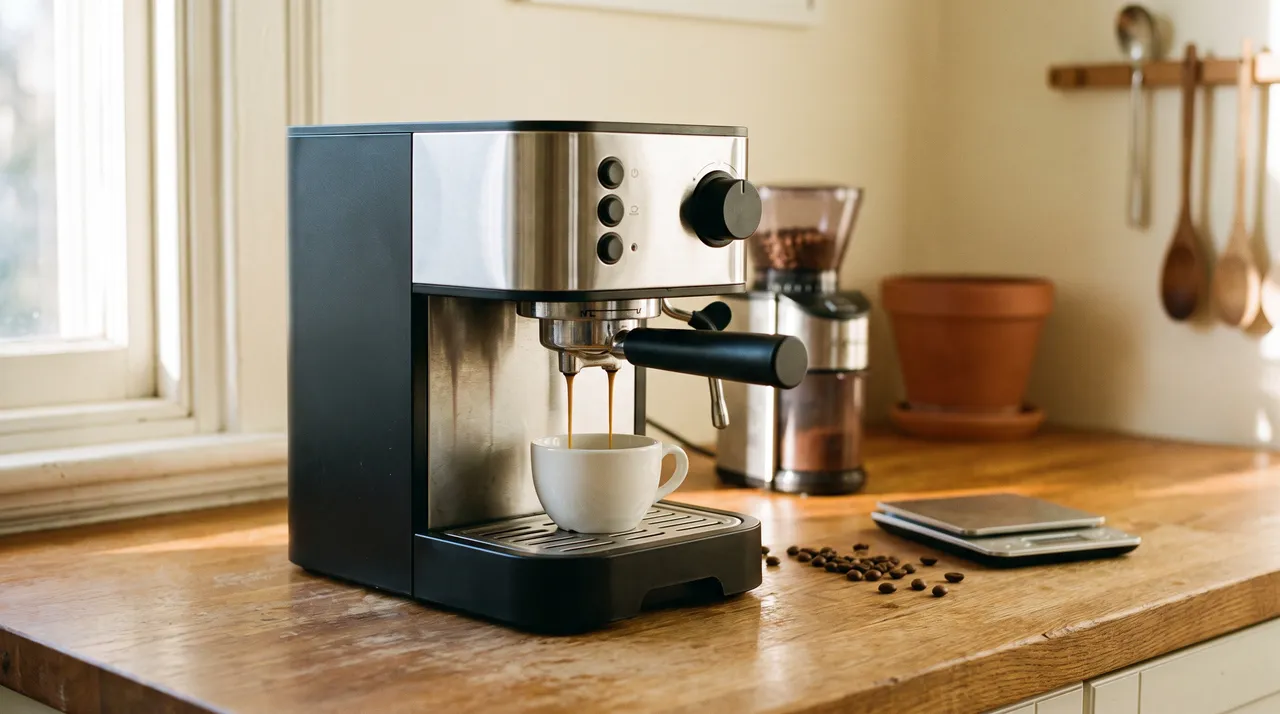
If you want the grinder in the same box, the Ninja Luxe Café Mini ($449.99) weighs and tamps the coffee for you. That’s the best espresso machine for home beginners who don’t want to learn a whole new hobby before breakfast.
Full disclosure before we go further. I make my coffee on a pearl white Nespresso Vertuo Up, and before that I ran a Vertuo Next from the week it launched.
I have not owned these five machines and I’m not going to pretend otherwise. What follows comes from each manufacturer’s own specs and prices, and a lot of owner threads about what breaks and what doesn’t.
Where I’m talking from my own counter, I’ll say so. The Nespresso section near the end is that part.
The best beginner espresso machines at a glance
- Best for BeginnersCheck Price
Small, fast and cheap enough to leave real money for a grinder
- Best with a GrinderCheck Price
Grinder, scale and assisted tamper in one box, so the dose is right every time
- Best Under $300Check Price
Real espresso in 3 seconds, with a manual steam wand, for under $300
- Best for LearningCheck Price
Italian-made prosumer machine with commercial steam wand and 58 mm portafilter
| Machine | List price | Grinder | What it does for you | Milk |
|---|---|---|---|---|
| Breville Bambino Plus | $499.95 | Separate, or pre-ground | Dual-wall baskets, 3-second heat-up | Automatic steam wand |
| Ninja Luxe Café Mini | $449.99 | Built in, 60 settings | Weighs the dose, assisted tamper, grind suggestions | Manual steam wand |
| Breville Bambino | $299.95 | Separate, or pre-ground | Dual-wall baskets, 3-second heat-up | Manual steam wand |
| De’Longhi Stilosa | $149.95 | Use pre-ground | Not much, and that’s the price | Manual steam wand |
| Gaggia Classic Pro E24 | $549 | Separate | Very little, on purpose | Commercial steam wand |
List prices come from each manufacturer’s US site, checked September 2026. Amazon prices move every day, so hit the button on each pick for the current number.
Five picks, not ten. Each one on this list does a job the others don’t. The machines I left off get their own short section further down, with the reason for each.
What a beginner espresso setup really costs
Here’s the part most buying guides skip. An espresso machine is half a purchase. The other half is the grinder.
Espresso needs coffee ground fine and even enough to push back against about 9 bars of pressure. Pre-ground coffee goes stale fast once the bag is open, and a cheap blade grinder can’t make particles even enough. Either way, the water finds the easy path through the coffee and your shot runs thin and sour.
So price the whole setup, not the machine:
| Setup | Machine | Grinder | Total | What you give up |
|---|---|---|---|---|
| Stilosa, pre-ground coffee | $149.95 | None | ~$150 | Freshness, and a low ceiling on how good it gets |
| Ninja Luxe Café Mini | $449.99 | Built in | ~$450 | A grinder you can replace on its own |
| Bambino + Smart Grinder Pro | $299.95 | $199.95 | ~$500 | Automatic milk |
| Ninja Luxe Café Premier | $599.99 | Built in | ~$600 | Same as the Mini, but you gain hands-free milk |
| Bambino Plus + Smart Grinder Pro | $499.95 | $199.95 | ~$700 | Counter space, because it’s two boxes |
| Gaggia Classic Pro E24 + Smart Grinder Pro | $549 | $199.95 | ~$750 | An easy first month |
- 60 grind settings with dosing by time in 0.2 second increments
- Grinds directly into a 54 mm portafilter, no cradle swap needed
- Stainless steel conical burrs
The short version: a complete setup that grinds fresh beans starts at $450 in one box, or $500 in two.
Two boxes cost you counter space. In return, you can replace or upgrade the grinder without touching the machine. One box saves money and does the dosing and tamping for you, but when the grinder wears out, it takes the machine with it.
For a beginner, that one-box trade isn’t a bad one. Weighing the dose and tamping evenly are the two things that wreck most first shots, and the Ninja does both for you.
Whichever way you go, the grinder needs dialing in when you open a new bag of beans. Learning how to calibrate a coffee grinder will save you more bad shots than any machine upgrade.
What else you need besides the machine
The box isn’t the whole shopping list. Before your first shot, check you’ve got these:
- A kitchen scale that reads to 0.1 gram. Espresso is measured by weight, in and out. The Ninja has one built in. Everyone else needs one.
- A milk jug. Breville includes one with both Bambinos. For the others, a small stainless steel pitcher is all you need.
- A better tamper, maybe. Breville and Gaggia include a usable one. The Stilosa’s is basic, and it’s the first thing owners replace.
- Descaler. Hard water scales up the inside of every machine on this list. Use the descaler the manual names, on the schedule it gives.
- Fresh beans. Look for a roast date on the bag, not a best-before date.
None of that is expensive. Skip the scale, though, and you’re guessing at every shot.
Pressurized baskets: why you can start without a grinder
This is the thing I wish someone had told every beginner. You don’t have to buy a grinder on day one.
A pressurized basket, which Breville calls dual-wall, has a double floor with one small exit hole. That hole builds the resistance for you, so pre-ground coffee still makes a shot with foam on top. A standard single-wall basket has a floor full of holes and relies on fresh, fine, even grounds to build that resistance itself.
Breville ships both kinds of basket with the Bambino Plus, and the Bambino gets the same pair. So here’s the plan:
- Start on the dual-wall basket with a good bag of pre-ground espresso.
- Learn the steam wand, the timing and your cup sizes.
- Buy a grinder when you’re sure the habit is sticking.
- Switch to the single-wall basket that same week.
Be clear about what the dual-wall basket costs you. The foam looks like crema and isn’t quite, and every shot tastes more alike whatever you change. Treat it as the way in, not the place to stay.
Breville Bambino Plus: best espresso machine for beginners overall
- ThermoJet heating element reaches brew temperature in about 3 seconds
- Automatic milk texturing with adjustable temperature and foam level
- Compact footprint, roughly 7.7 inches wide
Buy this if you want lattes and flat whites that come out right from day one.
The Bambino Plus is small, fast and forgiving. Breville’s ThermoJet heater gets it to brewing temperature in 3 seconds, so there’s no long warm-up before your first coffee. It runs a low-pressure pre-infusion to wet the coffee, then extracts at 9 bar.
You get the 54mm portafilter, a tamper, a milk jug, and both single-wall and dual-wall baskets in the box.
The automatic steam wand is the reason it wins. Put the jug on the tray, pick one of 3 milk temperatures and one of 3 foam levels, and walk away.
Milk is the hardest skill in home espresso, and this machine takes it off your plate until you want it back. When you do, you can steam by hand.
What’s annoying about it (these are the complaints that come up most in owner threads):
- The water tank sits at the back, which is a pain under low cabinets.
- You can’t brew and steam at the same time.
- The 54mm portafilter has fewer aftermarket baskets and tampers than 58mm.
- The automatic milk only works with the jug sitting on the tray.
Grinder situation: start on pre-ground in the dual-wall basket, then add a grinder. Budget $200 for the Smart Grinder Pro.
Realistic spend: $500 to start, $700 once you add the grinder.
Why not the Ninja for overall? Two reasons. You can start at $500 and buy the grinder later instead of paying for it up front.
The other reason is track record. The Bambino Plus has seven years of owner reports behind it, and the Luxe Café line has about two.
Ninja Luxe Café Mini: best beginner espresso machine with a grinder
- Conical burr grinder with 60 grind sizes
- Built-in scale doses coffee by weight
- Assisted tamper and Barista Assist grind recommendations
Buy this if you want fresh-ground espresso without learning to weigh, dose and tamp.
This is the machine the beginner market has moved to, and the old version of this page didn’t even mention it. Per SharkNinja’s spec sheet for the Luxe Café Mini, you get:
- A conical burr grinder with 60 grind sizes
- A built-in scale that doses the coffee by weight
- An assisted tamper in the box
- “Barista Assist,” which recommends a grind setting and adjusts brew temperature and pressure
- A manual steam wand
- Drip-style coffee as well as espresso, brewed classic, rich or over ice
That list covers the three places beginners go wrong: grind, dose and tamp. The machine handles or guides all three.
What’s annoying about it:
- One grinder serves both espresso and drip, so the espresso end of the range isn’t as fine-tuned as a dedicated espresso grinder. Reviewers and owners say this consistently.
- Everything is proprietary. There’s no aftermarket basket, tamper or portafilter scene like Breville and Gaggia have.
- It’s new. There’s far less long-term owner data than for any Breville on this page.
- The steam wand is manual, so milk is a skill you’ll have to learn.
If you want the milk done for you too, look at the Luxe Café Premier ($599.99). It adds 4 hands-free froth presets and a cold brew mode. Oddly, Ninja lists its grinder at 25 settings against the Mini’s 60.
Realistic spend: $450, and you’re done.
Breville Bambino: best real espresso machine under $300
- ThermoJet heating reaches brewing temperature in 3 seconds
- Single-wall and dual-wall baskets, so pre-ground coffee works
- Manual steam wand for hand-textured milk
Buy this if you drink espresso straight, or you want to learn milk by hand.
It’s the Bambino Plus with a manual steam wand, for $200 less. Same 3-second heat-up, same 54mm portafilter, same dual-wall and single-wall baskets. Breville builds it around an 18-gram dose.
It’s also the small-kitchen pick. Breville lists it at 11.9 x 6.1 x 13.5 inches.
What’s annoying about it: the manual wand takes practice. Everything else it shares with the Plus, including the tank at the back.
Grinder situation: same plan as the Plus. Pre-ground first, a $200 grinder later.
Realistic spend: $300 to start, $500 with the grinder.
One warning. Breville’s US site showed the Bambino as out of stock when I checked prices in September 2026. Amazon and other retailers usually still carry it.
De’Longhi Stilosa: best budget espresso machine under $200
- 15 bar pump pressure
- Manual milk frother with stainless steel boiler
- Slim, compact footprint
Buy this if $150 is the budget and you want to find out whether espresso is for you.
De’Longhi lists the Stilosa at $149.95. It has a 15-bar pump, a stainless steel boiler, a manual steam wand and a 33.8 oz water tank. It makes a single or a double.
Be clear about what $150 buys. You get a machine that makes a decent shot from good pre-ground coffee, and milk that’s fine for a latte once you get the hang of the wand. You don’t get a machine you’ll dial in.
What’s annoying about it: owners mostly complain that it’s slow to switch from brewing to steaming, and that the included tamper is basic enough to be worth replacing.
Realistic spend: $150, plus a bag of pre-ground espresso.
If you can stretch to $300, the Bambino is a big step up in speed and shot quality.
Gaggia Classic Pro E24: best espresso machine if you want to learn properly
- Made in Italy, brews at the optimal 9 bars
- Commercial steam wand for milk texturing
- Heavy-duty 58 mm portafilter with single, double, and ESE baskets
Buy this if you want espresso to be a hobby, not a button.
This is the hardest machine on the list, and that’s the point. The Gaggia Classic has been the machine people learn on for decades, and the E24 is the current US version. Gaggia North America lists it from $549 in stainless steel.
What you get:
- A commercial-size 58mm portafilter, so every basket, tamper and accessory made fits it
- A brass boiler
- A 3-way solenoid valve, which releases pressure after the shot so the puck comes out dry
- A pump set to 9 bar
- A commercial-style steam wand with a two-hole tip
- A 72 oz water tank
What you don’t get is PID temperature control. Temperature drifts, and you learn to manage it.
The single boiler means you wait between pulling a shot and steaming milk. The wand is powerful and unforgiving.
That solenoid valve matters more than it sounds, because it lets you backflush the machine with cleaner. Backflushing is the core of learning how to clean an espresso machine properly, and the Bambino and Stilosa can’t do it.
Grinder situation: it needs a real grinder to make sense. Don’t buy this and run pre-ground through it.
Realistic spend: about $750 with the Smart Grinder Pro.
Ask on r/espresso which machine to learn on and this is still the one people point at. Parts are cheap, repairs are simple, and a well-kept one runs for a long time.
Machines I left off, and why
A few machines show up on every beginner list. Here’s why they’re not on mine.
- Breville Barista Express ($699.95). This was the old version of this page’s “Best Overall.” It’s still sold and still fine: 16 grind settings and PID at 200°F. But the Ninja Luxe Café Mini weighs and tamps for you at $250 less. The newer Barista Express Impress ($799.95) adds assisted tamping, but that’s past a beginner budget.
- De’Longhi Dedica EC685M ($279.95). It’s 6 inches wide, which is its big selling point. But the Bambino costs $20 more and heats up in 3 seconds. It was also out of stock at De’Longhi when I checked.
- Flair NEO Flex. It’s a lever machine with no pump and no electricity. You need a kettle, a burr grinder and practice. It’s a great second espresso maker and a rough first one.
- The $100 “20-bar” machines on Amazon. See the next section.
Ignore the 20-bar sticker
Cheap machines love a big pressure number: 15 bar, 20 bar. It sounds like more is better. It isn’t.
When the Specialty Coffee Association surveyed professionals, the most common extraction pressure was 9 bars, with an average of 8.5. Most brewed at 195-205°F, and the typical ratio was 1:2, say 18 grams of coffee in and 36 grams of espresso out.
The number on the box is the most the pump can push. It isn’t the pressure your coffee sees, so a 20-bar sticker on a $100 machine tells you nothing about the shot.
Look at the baskets, the heat-up time and the steam wand instead.
If you want a button, not a hobby
Maybe you’ve read this far and thought: I just want a latte at 6am without weighing anything. That’s fair. You’ve got two honest options.
Option one: a bean-to-cup machine. It grinds, doses, tamps, brews and froths milk from one button. You give up control and pay more.
I cover those in my picks for the best espresso machine under $1000, where the De’Longhi Magnifica Evo is the bean-to-cup pick. That page is also where to go when you outgrow a $300 machine.
Option two: a capsule machine. This is what I use, so here’s the first-hand bit.
- Ready to brew in 3 seconds
- Reads a barcode on each capsule and sets the brew for you
- Six cup sizes, from a 1.35 oz espresso up
My machine is a pearl white Nespresso Vertuo Up. My everyday mug is Arondio. When I want espresso, my go-to is Altissio, which makes a 1.35 oz shot.
From switched off to coffee in the cup takes me under a minute. Nespresso says the Up is ready to brew in 3 seconds.
It reads a barcode on each capsule, and Nespresso’s Vertuo factsheet says that barcode sets 5 things: cup size, temperature, rotation speed, flow rate and how long the water stays in contact with the coffee. You don’t choose any of it.
That’s the strength and the limit. The Vertuo is fast, simple and dead consistent, and every Altissio tastes like the last one.
A pump machine is more flexible, because you can put any coffee you like through it. On a Vertuo, you drink what Nespresso makes.
It also isn’t espresso in the SCA sense. The Vertuo spins the capsule to extract it, instead of forcing water through the coffee at 9 bar.
As a coffee snob, I know that. I drink it every morning anyway.
How to choose your first espresso machine
Four questions. Answer them honestly and the choice makes itself.
Do you drink milk drinks?
If yes, and you want them easy, buy the Bambino Plus. If yes, and you want to learn to steam by hand, get the Bambino or the Gaggia.
If you’re not sure what you order at the café, read up on flat white vs cappuccino first. The milk texture you like decides how much the steam wand matters.
Built-in grinder or separate?
A built-in grinder saves money and counter space: $450 for the Ninja Mini, all in. A separate grinder costs a bit more ($500 for the Bambino plus the Smart Grinder Pro), but you can upgrade either half without replacing the other.
How much counter do you have?
Breville lists the Bambino at 11.9 x 6.1 x 13.5 inches and the Bambino Plus at 11.9 x 7.4 x 14.3 inches. A separate grinder adds another footprint next to it. Measure under your cabinets, too, because you’ll be lifting a water tank or a bean hopper out the top.
Do you want to learn, or do you want it done for you?
The Gaggia is for learning. The Ninja does the dosing and tamping. The Bambino Plus sits between them.
One more thing on portafilter size: 58mm (the Gaggia) is the commercial standard, so every accessory fits. 54mm (the Bambinos) has a decent aftermarket too.
Your first shot: the numbers to aim for
You’ve bought the machine. Here’s where to start, using the averages from that same SCA survey of professionals:
- Dose 18 grams of coffee into the double basket. It’s also the dose Breville builds the Bambino around.
- Aim for 36 grams of espresso in the cup. That’s a 1:2 ratio. Put the cup on your scale.
- Time it. About half the pros in the survey average 25 to 30 seconds per shot.
- Too fast and sour? Grind finer. Too slow and bitter? Grind coarser. On a dual-wall basket with pre-ground coffee, you can’t change the grind, so adjust the dose a gram at a time instead.
- Change one thing at a time. Two changes at once and you won’t know which one helped.
Your first dozen shots will be so-so. That’s normal, and it’s why the machines at the top of this page do so much of the work for you.
FAQs
Are espresso machines worth it for beginners?
Yes, if you drink espresso or milk drinks most days and you’ll give it a month to get good. No, if you mostly drink a big mug of regular coffee. Then a stovetop pot or a drip machine makes more sense, and my moka pot vs espresso machine comparison covers the cheaper route.
Are espresso machines better than Nespresso?
For flavor and choice of coffee, yes. You can use any beans, and a good machine with a grinder makes a better shot.
For speed and zero effort, no. My Vertuo gets me from off to coffee in under a minute, and I don’t have to clean a portafilter.
Can espresso machines make regular coffee?
Not drip coffee, unless you buy a combo machine like the Ninja Luxe Café, which brews both. Any espresso machine makes an Americano, which is a shot topped up with hot water. It’s close to regular coffee but not the same thing.
Are espresso machines easy to use?
The first two on this list are about as easy as real espresso gets. The Bambino Plus steams milk for you, the Ninja weighs and tamps for you, and the dual-wall baskets forgive pre-ground coffee. Expect a week or two of so-so shots anyway.
Is Breville the best espresso machine brand for beginners?
Breville makes two of my five picks, for good reasons: dual-wall baskets in the box and a 3-second heat-up. Ninja is the newer challenger, and it does more of the work for you. De’Longhi owns the budget end, and Gaggia is the one to learn on.
So which one should you buy?
Buy the Breville Bambino Plus if you want the best first espresso machine for most people. Start on pre-ground coffee and add a grinder when the habit sticks. Buy the Ninja Luxe Café Mini if you want the grinder in the same box. Buy the De’Longhi Stilosa if $150 is the budget.
Then spend what’s left on good beans.