The best home coffee roaster for most beginners is the Fresh Roast SR540, at about $219. It roasts 3 to 4 oz of beans in under 10 minutes. Want a full pound at a time, indoors? Buy the Behmor 2000AB Plus.
I don’t roast at home, and I haven’t had these five on my counter. My coffee comes out of a Nespresso Vertuo. This page is built from the makers’ manuals and spec sheets, US retail prices, and what owners report in long-running roasting threads.
The comparison table comes first, then how big a roaster you need, then each pick and what’s annoying about it.
- Best for BeginnersCheck Price
A glass-chamber air roaster that does 3 to 4 oz in under 10 minutes, so you watch and hear every roast
- Best for IndoorsCheck Price
An electric drum roaster that does a full pound at a time, built for indoor use with smoke suppression
- Best SplurgeCheck Price
An air roaster that runs saved profiles, so you get the same roast every time
- Cheapest Way InCheck Price
Nuvo Eco Ceramic Handy Roaster
A ceramic shaker you hold over the stove: the cheapest way to find out if you like roasting
The best home coffee roasters compared
| Roaster | Type | Batch (green beans) | Roast time | Smoke | US price |
|---|---|---|---|---|---|
| Fresh Roast SR540 | Air (fluid bed) | 3-4 oz (85-115 g) | Under 10 min | Needs a hood or window | $219 |
| Fresh Roast SR800 | Air (fluid bed) | 6-8 oz (170-226 g) | 8-12 min | Needs a hood or window | $334 |
| Behmor 2000AB Plus | Drum | Up to 1 lb (454 g) | 8.5-18 min | Smoke suppression, indoor use | $479 |
| Kaffelogic Nano 7 | Air (fluid bed) | 4.2 oz (120 g) | Under 10 min | May set off a smoke alarm | $1,439 |
| Nuvo Eco Ceramic | Handheld, on the stove | Small handfuls | Depends on you | All of it stays in your kitchen | About $36 |
Prices checked at US retailers on 7 November 2026. Amazon prices move, so check the button before you buy.
All five plug into a normal US outlet except the Nuvo, which goes over a stove burner.
Which one should you buy? Start here:
- Roasting for yourself, first roaster: SR540.
- Two coffee drinkers in the house: SR800.
- You want to roast in the kitchen, not the garage: Behmor 2000AB Plus.
- You want saved profiles and repeatable roasts, and money isn’t the issue: Kaffelogic Nano 7.
- You’re not sure you’ll stick with it: Nuvo, for the price of a bag of coffee.
How big a roaster do you need?
Batch size is the spec that matters most, and the one nobody explains. Four ounces sounds like plenty until you’re roasting four times a week.
Here’s what you’d roast in a week, at the Specialty Coffee Association’s brew ratio of 55 g of coffee per liter of water. That’s about 13 g per 8 oz cup. Beans lose weight as they roast, and a lab study measured 14.4% to 17.2% weight loss, so the table assumes about 15%.
| You drink | Green beans a week | SR540 (3-4 oz) | SR800 (6-8 oz) | Behmor (1 lb) | Kaffelogic (4.2 oz) |
|---|---|---|---|---|---|
| 1 cup a day | 3.8 oz (107 g) | 1 roast | 1 small roast | 1 quarter-pound roast | 1 roast |
| 2 cups a day | 7.5 oz (214 g) | 2 roasts | 1 roast | 1 half-pound roast | 2 roasts |
| 4 cups a day (two people) | 15.1 oz (428 g) | 4-5 roasts | 2-3 roasts | 1 full-pound roast | 4 roasts |
| 6 cups a day | 22.6 oz (642 g) | 6-8 roasts | 3-4 roasts | 2 roasts | 6 roasts |
One coffee drinker is fine with a 3 to 4 oz air roaster. If two of you drink four cups a day between you, buy the SR800 or the Behmor, or you’ll be roasting most days of the week.
Don’t roast a month ahead to save effort. Roast what you’ll drink in a week or two, and store roasted beans in something airtight.
Best for beginners: Fresh Roast SR540
- Fluid-bed air roasting in a glass chamber
- Nine heat settings, separate fan control and a live temperature display
- Rated at 4 scoops, about 120 g of green coffee per batch
Pros
- You can see the color change and hear first crack
- Full roast in under 10 minutes
- The cheapest electric roaster worth buying
Cons
- Small batch: two heavy drinkers will roast most days
- No smoke control, so it needs a hood, window or garage
Buy this if you’re roasting for yourself and want to learn on a machine that shows you everything.
The SR540 is a fluid-bed air roaster. A fan blows hot air up through a glass chamber, and the beans tumble in it like popcorn. Fresh Roast rates it at 4 scoops, about 120 g of green coffee, but plan on 3 to 4 oz per batch. Fresh Roast says that makes 7 to 14 cups of coffee in under 10 minutes.
You get nine heat settings, separate fan control and a live temperature readout. That’s more control than you’ll use in your first month, which is the point. You grow into it.
The glass chamber is the reason it’s the beginner pick. You watch the beans go from green to yellow to brown, and you can hear the pops. Learning to hear first crack is half of learning to roast, and an opaque machine hides it from you.
What’s annoying about it: the batch is small, so two heavy coffee drinkers will roast four or five times a week. And there’s no smoke control at all. Roasting guides for it say to run it under a range hood, beside an open window or in the garage.
Best for two coffee drinkers: Fresh Roast SR800
- Fluid-bed air roasting in a glass chamber
- Variable heat and fan control with a digital display
- Roasts 6 to 8 oz (170 to 226 g) per batch
Pros
- About double the SR540's batch
- Still quicker than a drum roaster
- Sold in bundles with a taller extension tube for full batches
Cons
- $115 more than the SR540
- No smoke control, and twice the smoke per roast
Buy this if you like the SR540 idea but there are two of you drinking it.
Same design, bigger chamber. Fresh Roast lists it at 6 to 8 oz (170 to 226 g) per batch, about double the SR540. It keeps the variable heat, fan control and digital display.
A bigger batch takes longer. Roasting tip sheets for the SR800 put second crack at 10 to 12 minutes, so most roasts land between 8 and 12. That’s still quicker than a full pound in the Behmor.
Fresh Roast sells it in bundles with a taller glass extension tube. Owner threads keep saying it helps with full batches, because the beans have more room to move and roast more evenly. If you’re buying the SR800 to roast at its full capacity, get the bundle.
What’s annoying about it: it’s $115 more than the SR540. And it’s still a hood-or-window machine, now making twice the smoke per roast.
Best for roasting indoors: Behmor 2000AB Plus
- Electric drum roaster, up to 1 lb (454 g) per batch
- Built-in smoke suppression, rated for indoor use only
- Preset roast times for quarter, half and full pound batches
Pros
- Biggest batch on the list by far
- The one roaster here meant to run in your kitchen
Cons
- Slow: 18 minutes for a full pound
- Never roast past 10 seconds into second crack, so no very dark roasts
- Needs a dry burn and clean every five roasts
Buy this if you want a pound at a time and the roaster has to live in your kitchen.
The Behmor is an electric drum roaster about the size of a toaster oven. The beans tumble in a rotating drum behind a glass door, and it roasts up to 1 lb (454 g) in one go.
It’s the one roaster here built for indoor use. Behmor’s manual says it’s “intended for indoor use only”, and claims its smoke suppression takes a full pound to second crack without visible smoke. Read the next line in the same manual too: if you see heavy smoke, cool the roast immediately. Suppression has limits.
The default roast times tell you how slow drum roasting is: 18 minutes for a pound, 12 for half a pound, 8.5 for a quarter. You’ll spend that time standing next to it, because the manual says flatly that it’s not a set-and-walk-away device.
What’s annoying about it: it’s slow, $479 is a jump from the SR540, and you can’t take it dark. Behmor says never roast more than 10 seconds into second crack. That rules out French and Italian roasts. It also wants a dry burn and an interior clean every five roasts.
Best splurge: Kaffelogic Nano 7
- Fluid-bed air roasting with variable temperature and airspeed
- Preloaded roast recipes, plus profiles you can build, save and share
- 120 g per batch, 50 to 200 g with the Boost kit (sold separately)
Pros
- Repeatable roasts without babysitting the controls
- Under 10 minutes per roast
Cons
- Expensive for a 4.2 oz batch
- May set off a smoke alarm, per Kaffelogic's own manual
- Pick the 110 V version: the listing also sells 220 V models
Buy this if you want the same roast every time, and you’ll pay to stop babysitting.
The Nano 7 is an air roaster that runs saved profiles. Kaffelogic’s spec page lists 120 g per batch, under 10 minutes, and variable temperature and airspeed. Its Boost kit, sold separately, stretches the range to 50 to 200 g.
What you’re paying for is control. It ships with preloaded roast recipes, and you can build your own profiles, save them and share them. Find a roast you like and you can repeat it next week without guessing.
It runs at 1,400 W and comes in a 110-120 V US version. On Amazon, make sure you’ve picked the Nano110 option, because the same listing sells 220 V models that won’t work in a US kitchen.
Don’t read “automated” as “smoke-free”. Kaffelogic’s own manual warns it may set off a smoke alarm during normal use, and says to run it beside an open window, range hood or extractor fan.
What’s annoying about it: about $1,439 for a 4.2 oz batch. That’s six SR540s and change, for roughly the same capacity. The money buys repeatability, not volume.
Cheapest way to try roasting: Nuvo Eco Ceramic Handy Roaster
- All-ceramic body with a cowhide grip
- Waffle-pattern interior to help the beans roast evenly
- Rear hole so you can hear the beans pop
Pros
- Costs about the same as a bag of specialty coffee
- Nothing to plug in
Cons
- You shake it by hand for the whole roast
- Small batches and uneven results
- All the smoke and chaff stay in your kitchen
Buy this if you’re not sure home roasting is for you and you’d rather find out for $36.
The Nuvo is a ceramic shaker with a cowhide grip. You hold it over a burner and keep it moving. A waffle pattern inside helps the beans roast evenly, and a hole in the back lets you hear them pop.
The listing doesn’t give a capacity. Owners report the best results from small amounts, about enough for a couple of mugs.
It won’t match any machine here. You’re the fan and the drum, so evenness depends on how steady your arm is.
What’s annoying about it: you shake it for the whole roast, and every bit of smoke and chaff stays in your kitchen. Think of it as a test, not a roaster you’ll keep.
Also considered
- Gene Café CBR-101: a well-liked hot-air roaster with a 250 g tumbling glass chamber. Gene Café’s own spec page lists only a 220-240 V model, and I couldn’t find it sold new on Amazon US.
- Kaldi Motorized: a small drum that sits on top of a separate gas burner. Most beginners don’t own the burner, which makes it a poor first roaster.
- IKAWA Home: an app-controlled 100 g air roaster priced at £1,490 on IKAWA’s UK store, with no current US price.
- Popcorn poppers: people do roast in them. They weren’t built for it, and you get almost no control. If you want cheap, the Nuvo is at least made for coffee.
Air vs drum roaster: which should you buy?
Every roaster here is one of two types. Air roasters push hot air through the beans. Drum roasters tumble them in a heated, rotating drum.
| Air (fluid bed) | Drum | |
|---|---|---|
| How the beans heat | Hot air blown through the beans | Tumbling in a heated drum |
| Batch on this list | 3-8 oz | Up to 1 lb |
| Roast time | Under 10 minutes to about 12 | 8.5-18 minutes |
| Can you see the beans | Through glass on the Fresh Roast models | Through the door window |
| Smoke | Vented into the room | Behmor suppresses it |
| Price on this list | $219-$1,439 | $479 |
| Best for | One or two drinkers who want to watch every roast | Bigger batches, roasting in the kitchen |
Buy air if you roast for one or two and want fast roasts you can watch. Buy drum if you want a pound at a time with the roaster on your counter.
Don’t buy on flavor claims. Every roaster here covers light through medium-dark, so choose on batch size and where you’ll roast. Our coffee roast chart gives the temperatures behind each roast level.
Smoke, chaff and where to roast
Every roaster makes smoke. The question is how much reaches your smoke alarm.
- Fresh Roast SR540 and SR800: run them under a range hood, beside an open window or in the garage. They have no smoke control.
- Behmor 2000AB Plus: the only one built for indoor use. Stop by 10 seconds into second crack, the manual’s hard limit.
- Kaffelogic Nano 7: beside a window, hood or extractor fan. The manual warns it may trip a smoke alarm.
- Nuvo: on your stove with the hood on full.
- Chaff: the papery skin that comes off the beans as they roast. Kaffelogic says to brush its mesh filter after every roast. Behmor’s manual warns that “coffee beans can ignite,” and links fires to high-chaff coffee and roasts pushed past second crack.
- Stay in the room. Both the Behmor and Kaffelogic manuals tell you to stay with the roaster while it runs.
What home roasting costs to run
Green coffee is cheap. That’s the main reason people start roasting.
| Price | Per pound | |
|---|---|---|
| Green coffee, 1 lb bag (median at Sweet Maria’s) | $9.50 | $9.50 |
| The same pound after roasting (about 15% lighter) | About $11.20 | |
| Stumptown Hair Bender, 12 oz bag | $19.00 | About $25.30 |
| Counter Culture Big Trouble, 12 oz bag | $19.50 | $26.00 |
Prices checked November 2026. Most in-stock 1 lb bags of green coffee at Sweet Maria’s ran $9 to $10, from about $6 at the low end.
Home-roasted coffee costs less than half the price of a specialty bag. At two cups a day, the SR540 saves you about $5.70 a week against $25-a-pound coffee, so it pays for itself in about nine months. At four cups a day, the Behmor gets there in about ten. That ignores power, shipping and the batches you’ll ruin learning.
What else you need
Not much. The old “seven essential tools” lists are written for commercial roasteries.
- Green coffee. Start with a sampler from a home-roast supplier, so you learn on a few different beans.
- A kitchen scale. Weigh every batch. Scoops lie.
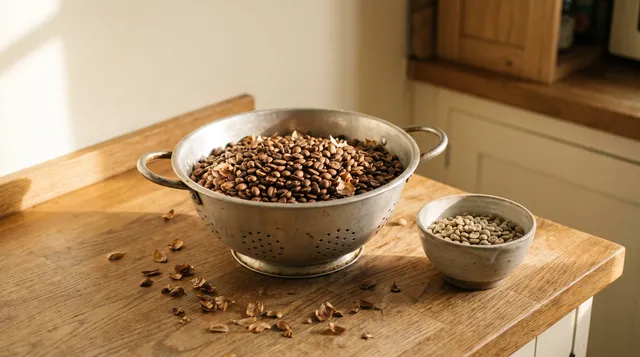
- Somewhere to cool the beans. The three electric roasters have a cooling cycle. With the Nuvo, tip the beans into a metal colander and shake them.
- An airtight container for the roasted beans.
Once it arrives, here’s how to roast coffee at home, step by step.
FAQs
What’s the best home coffee roaster for espresso?
The SR800, if you want enough beans to dial in a grinder. Espresso eats coffee fast, and most espresso roasts sit at medium to medium-dark, which every machine here handles. The Behmor works too, as long as you don’t need to go past 10 seconds into second crack.
Which home roaster is best for light roasts?
The SR540 or SR800. Light roasts are about stopping at the right moment, just after first crack, and the glass chamber lets you see and hear exactly when that happens. If you want the same light roast every time, the Kaffelogic’s saved profiles do that better.
What’s the best cheap home coffee roaster?
The Nuvo, at about $36, if you only want to try it. The SR540, at $219, is the cheapest electric roaster here worth buying for regular use.
Is there a good home coffee roaster under $1,000?
Yes. The Behmor 2000AB Plus at $479 is the most capable roaster here under $1,000, and the SR540 and SR800 sit well under it. The Gene Café usually comes up at this price, but its maker lists only a 220-240 V model, and I couldn’t find it sold new on Amazon US.