First crack is the popping sound coffee beans make at about 385-396°F (196-202°C), when steam pressure splits them open. It’s the point where the beans become drinkable coffee. What you do in the next few minutes decides your roast level.
I don’t roast at home. The temperatures, times and sounds here come from an acoustics study, roaster manuals and roasting guides, each linked where it’s used.
The sound comes first, because that’s how you’ll recognize it. Then when it happens, what to do, and where to stop.
What does first crack sound like?
Like popcorn. It starts with a few scattered snaps, then more beans join in. The easiest way to recognize it is to compare it with second crack, the next sound you’ll hear if you keep going.
| First crack | Second crack | |
|---|---|---|
| Sounds like | Popcorn popping | A fast, quiet crackle |
| Loudness | About 15% louder | Quieter |
| Pitch | Low, peaking around 800 Hz | High, peaking near 15,000 Hz |
| Pace | About 100 cracks a minute | Over 500 cracks a minute |
| Bean temperature | 385-396°F | 435-439°F |
| What’s happening | Steam splits the bean open | Gas pressure breaks the brittle bean, and oil starts to show |
The loudness, pitch and pace come from Wilson’s 2014 study of coffee roasting acoustics, which recorded a roast in a home drum roaster and measured every crack. It was one roast in one machine, so read the numbers as the size of the difference, not a spec your roaster will match.
First crack is louder, lower and slower. Second crack is quieter, higher and faster.
When does first crack happen?
At about 385-396°F bean temperature. How long it takes to get there depends on what you’re roasting in.
| Method | First crack starts at about |
|---|---|
| Hot-air popcorn popper | 3 minutes |
| Skillet over medium heat | 5 minutes |
| Oven at 500°F | 7 minutes |
| Home coffee roaster | Depends on the model and batch size |
The popper time comes from America’s Test Kitchen. The skillet and oven times come from Food Republic’s side-by-side test. For the full steps for each method, here’s how to roast coffee beans at home.
A roaster has no single answer, because batch size and heat setting move it. Write down the time on your first roast and use that as your baseline. It also helps to buy one you can watch. Our picks of home roasters you can see into include two with glass chambers, where you can see the beans swell as the cracking starts.
Why your roaster won’t show 385°F
Published first-crack temperatures range from 380°F to 405°F, and owners often see lower numbers on their own machines. A big part of the reason: home roasters don’t measure the beans.
Behmor’s manual is blunt about it. Its two readings are the exhaust channel and the chamber wall, and the manual says these “ARE NOT bean temps” and that you should never judge your roast by them.
Air and metal heat up and cool down at different speeds from a pile of beans, so a reading taken from either one won’t match bean temperature.
Go by the sound. The number on your display is a note for next time, not a target.
Why do coffee beans crack?
Green coffee holds water. As the beans heat up, that water turns to steam, the pressure builds, and the bean splits open as it expands. Behmor’s manual describes it the same way: the bean expands and gives off its water as steam. Wilson’s paper puts first crack at an internal temperature of about 392°F, with steam and other gases escaping.
Second crack is a different event. By then the bean is dry and brittle, and the gas building up inside breaks its structure apart. That’s why the second sound is faster and finer, and why oil starts to appear on the surface.
For what happens to the beans before first crack, the drying and browning phases, see our roast chart.
What to do when first crack starts
- Note the time. It’s the single most useful number you can write down. Next roast, it tells you whether you’re running faster or slower.
- Don’t cut the heat hard. Easing off a little keeps the roast from racing ahead. Cutting it hard can stall the roast, and a stalled roast tastes flat.
- Decide where you’re stopping. The table in the next section covers each roast level.
- Listen for the pops to taper off. Behmor’s manual says first crack lasts 1 to 1.5 minutes. Wilson’s paper puts it at about two.
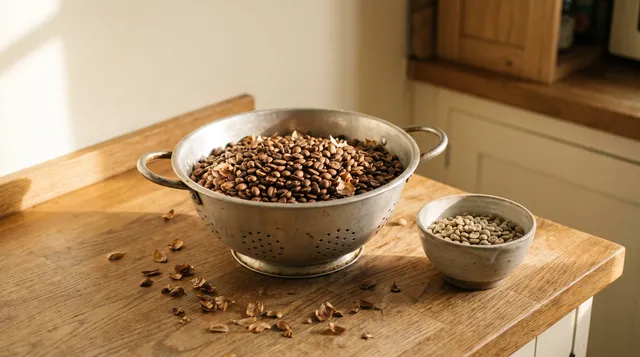
- Get the cooling colander ready. The beans keep roasting until they cool, so stop a little before the color you want.
The line worth remembering comes from Behmor’s manual: second crack “is not a requirement for ending your roast.”
You can stop any time after first crack starts. Everything after that is a choice about flavor.
Where to stop after first crack
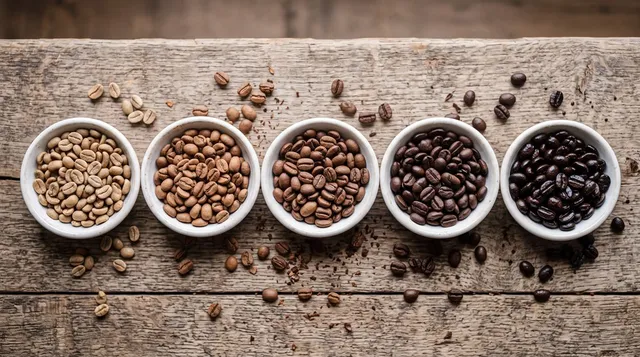
Your roast level depends on how long you keep going after first crack. These figures match our roast chart.
| Roast level | Where to stop | Bean temperature |
|---|---|---|
| Light | At first crack | 385-401°F |
| Medium-light | Just past first crack | 401-410°F |
| Medium | Well past first crack | 410-426°F |
| Medium-dark | Just before second crack | 428-435°F |
| Dark | Past second crack | 437-473°F |
Is first crack a light roast? Yes. Stop as it starts, or just after, and you have a light roast.
The time between first crack and the end of the roast usually runs 1 to 3 minutes. That’s where most of the flavor decisions happen. For the color, oil and flavor at each level, see the coffee roast chart.
How long after first crack is second crack?
In a hot-air popper, about 3 minutes: America’s Test Kitchen puts first crack at about 3 minutes and second crack at about 6. Bigger, slower roasters stretch the gap.
Behmor builds a button around this gap. Its manual says the “C” setting adds roughly the time from the first snaps of first crack to the start of second crack. Even the maker treats it as something you work out for each coffee.
First crack troubleshooting
| Problem | Likely cause | What to try |
|---|---|---|
| You can’t hear it | A loud popper fan, a closed roaster, or a quiet coffee | Watch for the beans swelling and the chaff lifting off. Turn off anything else making noise |
| It starts, then stops | Heat cut too hard | Ease the heat down in steps next time, not all at once |
| It comes very early | Too much heat, or too small a batch | Lower the heat or roast more beans |
| It comes very late | Too little heat, or too big a batch | Raise the heat or roast fewer beans |
| It runs straight into second crack | Too much heat through first crack | Ease off a little as first crack starts |
Some coffees are just quiet. Owners in roasting forums regularly report that natural-process coffees crack softly enough to miss. If you’re roasting one, rely more on color and smell.
FAQs
How long does first crack last?
One to two minutes. Behmor’s manual says 1 to 1.5 minutes, and the acoustics study measured about two.
Can you drink coffee roasted before first crack?
Not really. Before first crack, the beans haven’t developed enough to brew a decent cup. First crack is the earliest point they count as coffee.