A coffee roast chart does two jobs. It tells you the temperature and time each roast level needs, and it tells you what that roast level tastes like once it’s in the cup.
Most charts online only do one or the other. This one does both.
Light roasts finish at 385-401°F (196-205°C) in 6-9 minutes and taste bright and fruity. Medium roasts finish at 410-426°F (210-219°C) in 7-11 minutes and taste of caramel and nuts. Dark roasts finish at 437-473°F (225-245°C) in 12-15 minutes and taste smoky and bittersweet.
Those numbers are a starting point. Bean origin, batch size and your roaster’s airflow will shift them. Temperature control is what turns a chart into a repeatable roast.
Full disclosure: I don’t roast at home, and I’m not going to pretend otherwise. My daily coffee comes out of a Nespresso Vertuo. The temperatures, times and color readings here come from roaster makers, Coffee Review, roasting guides and published research, each linked where it’s used.
Key Takeaways
- First crack hits at 385-396°F (196-202°C) and marks the earliest point beans reach light roast territory.
- Second crack begins at 435-439°F (224-226°C) and marks the shift into dark roast territory.
- Light roasts keep the bean’s origin character. Dark roasts replace it with roast character.
- Surface oil is the fastest visual cue. Light and medium roasts stay dry, oil appears around Full City, dark roasts go glossy.
- Roast names like Cinnamon, City, French and Italian have no regulated standard, so one roaster’s French roast is another’s Vienna.
- Roast level barely affects caffeine. Your dosing method matters more than the roast.
The Coffee Roast Chart: Temperature and Time
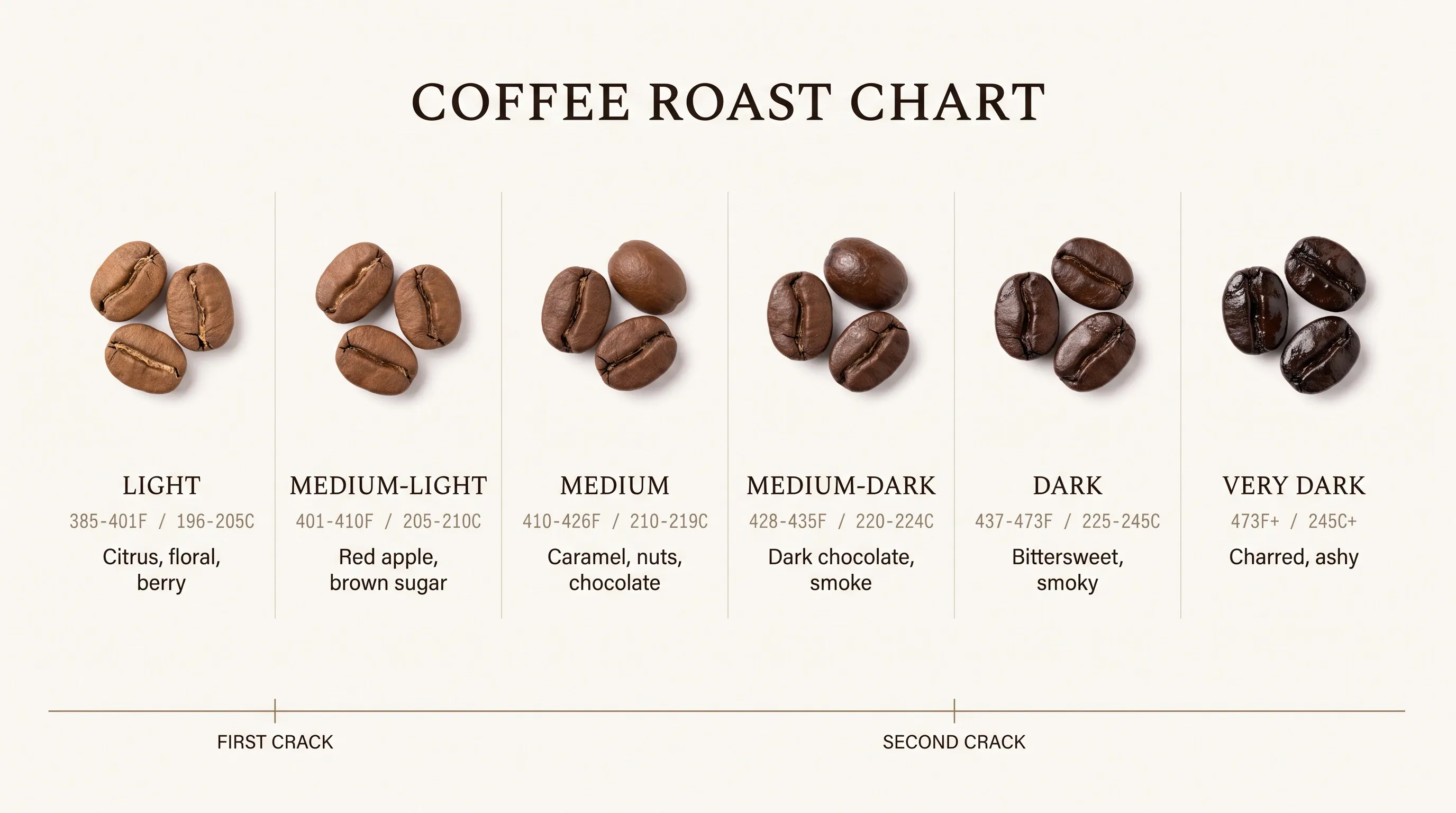
Roast level is defined by the internal bean temperature at the moment you pull the beans, not the temperature at any single point during the roast.
| Roast level | Finish temp (°F) | Finish temp (°C) | Roast time | Crack position |
|---|---|---|---|---|
| Light | 385-401°F | 196-205°C | 6-9 min | At first crack |
| Medium-light | 401-410°F | 205-210°C | 7-10 min | Just past first crack |
| Medium | 410-426°F | 210-219°C | 7-11 min | Well past first crack |
| Medium-dark | 428-435°F | 220-224°C | 10-13 min | Just before second crack |
| Dark | 437-473°F | 225-245°C | 12-15 min | Past second crack |
| Very dark | 473°F+ | 245°C+ | 15+ min | Well past second crack |
Knowing where your finish temperature sits relative to first and second crack is what lets you hit the same roast level batch after batch.
The Coffee Roast Chart: Color, Oil and Flavor
The same six levels, described by what you can see and taste.
| Roast level | Also called | Bean color | Surface oil | Flavor | Acidity / Body |
|---|---|---|---|---|---|
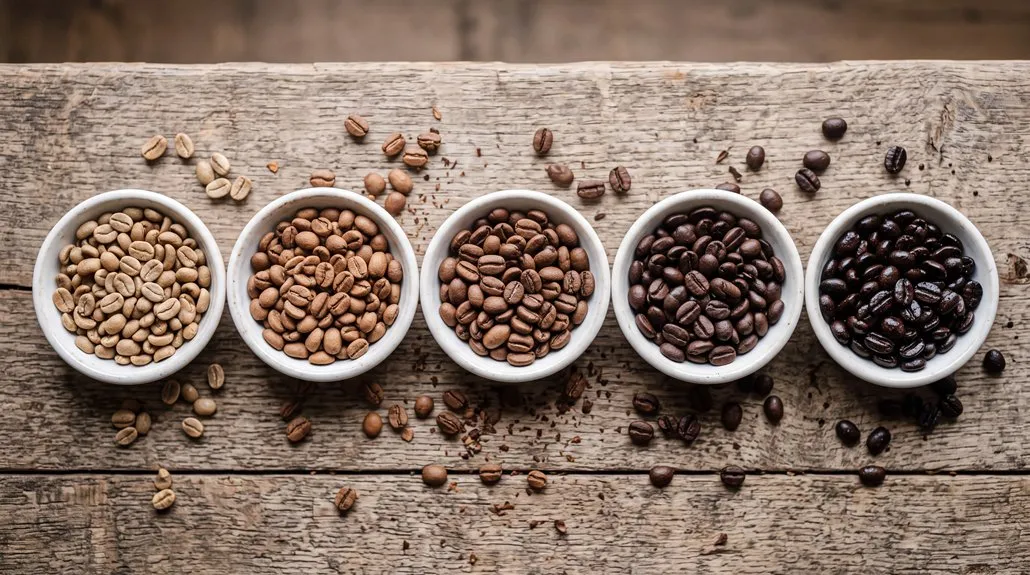
| Light | Cinnamon, Blonde, Half City, New England | Pale cinnamon brown | None, matte | Citrus, floral, berry, honey | High acidity, thin tea-like body |
| Medium-light | American, City | Light brown | None, matte | Red apple, brown sugar, nutty finish | Softened acidity, rounder body |
| Medium | City+, Breakfast, House, Regular | Milk chocolate brown | None, matte | Caramel, toasted nut, milk chocolate | Moderate acidity, medium body |
| Medium-dark | Full City, Full City+, Vienna | Rich dark chocolate | First patchy sheen | Dark chocolate, caramelized sugar, light smoke | Low acidity, full syrupy body |
| Dark | French, Continental, Espresso, New Orleans | Very dark brown | Visible gloss | Bittersweet chocolate, smoke, toasted nut | Very low acidity, heavy body |
| Very dark | Italian, Spanish, Neapolitan | Near black | Full wet gloss | Charred wood, tobacco, ash | Almost no acidity, heavy and flat |
One thing worth flagging: an oily light roast is not a roast level. It’s a freshness problem. Light roasts should be dry. If they’re slick, the beans are old.
The Roasting Phases Behind the Chart
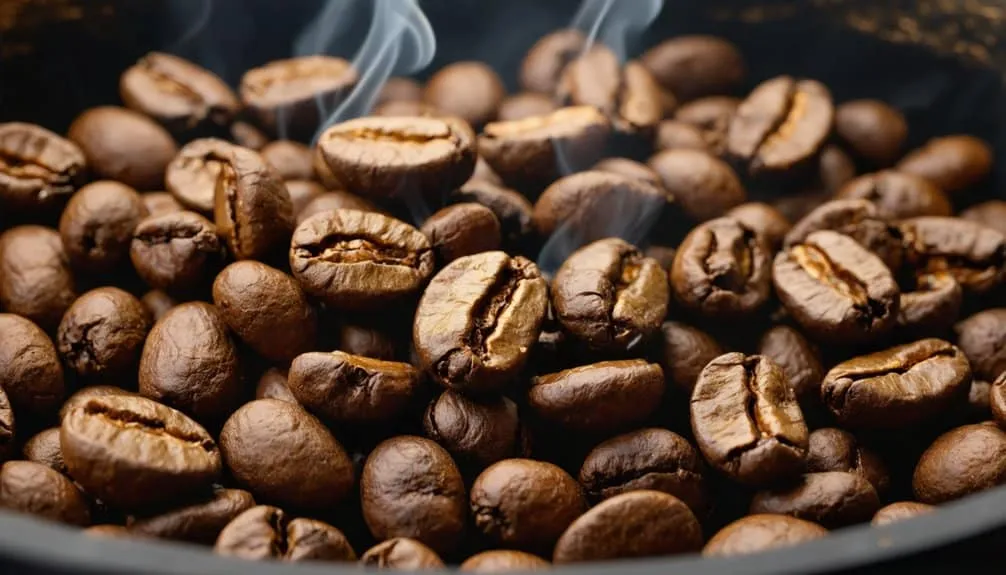
Every number in the chart above sits on the far end of three phases. Understanding them is what stops you chasing a temperature you haven’t earned.
Drying phase: 4-8 minutes, up to 320°F (160°C)
Green beans hold 10-12% moisture. This phase drives it off. The beans shift from bluish-green to straw yellow and the chaff loosens. You’ll catch a cereal-like aroma as early Maillard reactions start.
Rush this and you get underdeveloped beans. More on that below.
Maillard reaction: 4-6 minutes, 320-383°F (160-195°C)
Amino acids and sugars react and build the core flavor compounds. Yellows deepen toward tan. Watch color and aroma here rather than the clock. Steady temperature progression is what prevents a baked, flat cup.
First crack: 385-396°F (196-202°C), around 6-7 minutes in
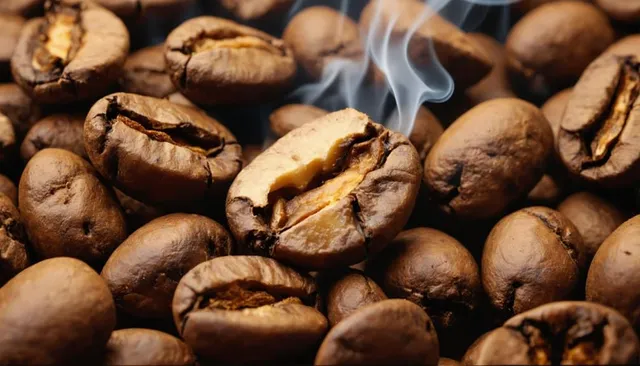
Moisture inside the bean turns to steam and the structure fractures with an audible pop, like popcorn. This marks the start of the development phase and the earliest point the beans count as drinkable coffee.
It’s preceded by the “A” point at 351°F (177°C), where volatile oils release the first real coffee aroma. Many roasters aim for the most balanced flavor somewhere between the two cracks. If you want the full breakdown, I’ve covered first crack in detail separately.
Development: 1-3 minutes after first crack
This is where you decide your roast level. Development time ratio, the percentage of total roast time spent after first crack, typically lands around 15-25%. Shorter for light, longer for dark.
Second crack: 435-439°F (224-226°C)
A quieter, faster crackle, more like crumpling paper. The cell structure breaks down and oils migrate to the surface. Acidity drops off sharply past this point and roast character starts to dominate the bean’s origin.
Cooling: below 104°F (40°C) within 4 minutes
Beans keep roasting on residual heat. Cool them to below 104°F (40°C) within four minutes or your finish temperature is a lie. How you cool the beans matters as much as how you roast them.
What the Roast Names Actually Mean
Roast names look random until you know where they come from. Some describe bean color, some describe a region, some describe a specific moment in the roast.
Light roast names come from color and regional brewing traditions. “Cinnamon roast” refers to the pale cinnamon-brown hue of beans pulled before first crack, not any spice in the cup. “Half City” and “Light City” mark beans dropped right as first crack begins. “New England” and “American” reflect regional preference for bright, origin-forward coffee.
Starbucks coined “blonde roast” around 2012 specifically to replace “cinnamon roast” and kill the flavor confusion. European roasters use the “blond” spelling, tied to Nordic light-roasting traditions.
Medium roast names lean on drinking context rather than color. American, Regular, Breakfast, House and City all point at the same comfortable middle ground. Breakfast Roast tends to sit lighter and brighter. House Blend sits a touch deeper with more caramel sweetness. City Roast is the classic medium benchmark.
Dark roast names lean on European geography to signal how far the beans have been pushed. Vienna sits at the entry point, mahogany-brown with moderate oil. Full City runs richer and rounder than standard City and bridges medium and dark. French goes well past second crack into smoky, oily territory. Italian pushes darker still. Spanish and Neapolitan mark the extreme edge.
Here’s the catch. There is no regulated standard for any of these names. One roaster’s French roast can look and taste noticeably different from another’s. Treat the names as flavor cues, not measurements.
Reading Bean Color and Surface Oil
The two fastest clues to a roast level are color and oil.
Color runs from pale cinnamon at the lightest roasts, through milk chocolate at medium, rich dark chocolate at medium-dark, and on to near-black. Coffee Review measures this precisely with a modified spectrophotometer called an Agtron, which assigns a numerical reading to whole bean and ground samples. Light-medium roasts sit around Agtron 55-62. Medium-dark espresso roasts sit around 48-54.
Surface oil tells a parallel story:
- Matte and dry means light through medium roast, no oil migration yet.
- Patchy sheen means medium-dark, roughly Full City, where oils first break the surface.
- Full gloss means dark roast, uniform and wet-looking.
- Oily light roast means stale beans, not a dark roast.
Those surface oils carry volatile aroma compounds, so they’re a flavor signal as well as a visual one.
Light Roast: Bright, Fruity, Origin-Forward
Light roast is where the bean does the talking. Lemon zest, jasmine, ripe berries, honey sweetness. These come from the origin, not the roaster’s drum.
“Bright acidity” is the term you’ll see, and it means a clean, sparkling tang, not the sour harshness of a bad extraction. It comes from intact organic acids, chlorogenic, quinic, citric and malic, which degrade fast once the roast pushes past 410°F (210°C). In green beans, chlorogenic acid levels reach up to 14% dry matter and are linked to antioxidant activity.
Origin character maps out roughly like this:
- Ethiopian beans deliver complex, high-acidity profiles. Naturally processed lots push blueberry and jasmine hard.
- Kenyan beans reveal a pronounced blackcurrant brightness.
- Colombian cups offer structured acidity balanced by sweetness.
- Guatemalan roasts bring tangy, lively notes shaped by altitude.
If you want the temperature detail, it’s in the chart above. The Ethiopian and Kenyan comparison is worth a read too if you’re picking beans for a light roast.
Medium Roast: The Balanced Middle
Medium roast is the most widely consumed level in the US, and the reason is straightforward. It gives you caramelized sweetness, toasted nut and chocolate in one cup, moderate acidity without sharpness, medium body, and enough origin character left to tell where the coffee came from.
Medium-light sits just below it and is where sweetness first steps forward. Caramel and brown sugar emerge, acidity softens, and the body moves from tea-like to something rounder. A Colombian medium-light with red apple brightness and a clean nutty finish is a good example of this zone.
If a light roast feels too sharp, moving one step darker usually smooths it out without losing the origin.
Medium-Dark Roast: Bold and Bittersweet
Past medium, the character shifts. Deep chocolate, caramelized sugar and smoky undertones replace the brighter notes. Body goes full, almost syrupy. Acidity drops noticeably.
Beans reach 428-435°F (220-224°C) here, right on the edge of second crack, and the first oils appear on the surface.
| Attribute | What you’ll taste | Why it happens |
|---|---|---|
| Flavor | Dark chocolate, toasted nuts, caramel | Maillard reactions and sugar caramelization |
| Body | Full, rich, syrupy | Extended roasting develops heavier mouthfeel |
| Acidity | Low | Organic acids degrade in later roast stages |
Dark and Very Dark Roast: Roast-Forward
Past second crack, it’s the roast talking, not the bean.
Bittersweet chocolate, toasted nuts and caramelized sugar dominate. Push to French or Italian and you get charred wood, tobacco and ash. Chlorogenic acids break down almost entirely, forming phenylindanes that drive bitterness. The body goes heavy and syrupy, which is what most people actually mean when they call a coffee “strong.”
Near 482°F (250°C), beans go almost black and burned notes take over. At that point most coffees taste the same regardless of origin, which rather defeats the purpose of buying good beans.
Dark roasting also needs careful heat management to avoid scorching, because you’re working close to the point where the beans catch.
How Roast Level Changes Acidity
Light roasts keep most of their citric, malic and chlorogenic acids. pH sits around 3.97 to 4.0, the lowest across roast levels.
Push darker and those bright acids break down. Quinic and caffeic acids form from chlorogenic acid degradation, and the profile shifts from lively acidity toward bitterness and astringency. Over 90% of chlorogenic acids break down during dark roasting. In their place, phenylindanes and quinolactones take over, and di-CQA mixtures increase bitter intensity while adding metallic and astringent qualities.
pH climbs to around 4.25 for dark roasts, so there’s less total sourness even though it tastes sharper.
Research on a commercial drum roaster found titratable acidity rises to a peak mid-roast and then continuously decreases as beans move into darker stages. That peak is worth knowing about if you’re chasing sweetness rather than brightness.
Does Roast Level Affect Caffeine?
Barely, and not in the direction most people assume.
Caffeine is heat-stable. It hardly breaks down at roasting temperatures. Lab analyses put light roasts at roughly 1.3-1.4% caffeine by weight against 1.1-1.2% for dark roasts. That’s a 10-15% difference on paper, which works out to about 6 mg per cup.
What actually matters is how you dose. Scoop by volume and dark roasts win, because the beans are puffier and less dense so more of them fit in a tablespoon. Weigh your coffee and light roasts edge ahead slightly.
The real caffeine lever is bean species. Robusta runs around 2.2% caffeine against roughly 1.2% for Arabica, which is nearly double. Roast level isn’t even close to that.
Matching Brew Method to Roast Level
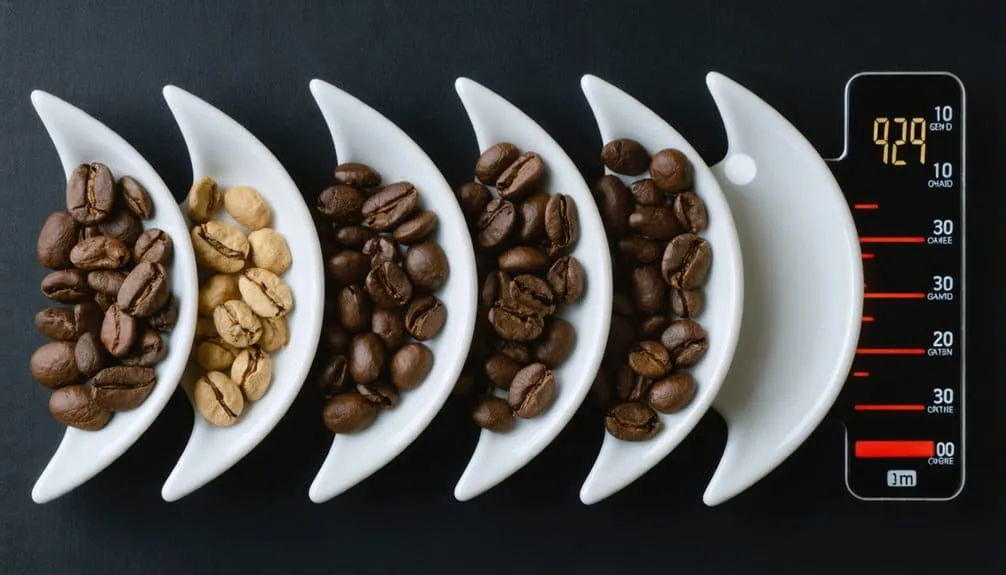
Matching method to roast level makes more difference than most people expect.
Light roasts: pour-over. Use a cone or flat-bottom dripper with paper filters. Paper removes oils and fines and gives you a cleaner cup where acidity and aroma come through. Start at a 1:15 to 1:16.5 ratio (20g coffee to 300-330g water), grind slightly finer than standard pour-over, and use water at 199-205°F (93-96°C). Light roasts are denser and less soluble, so they need the heat. Aim for 3:00 to 3:45 total.
Medium roasts: anything. This is the most forgiving level. V60 at 1:16 and 201-205°F (94-96°C) with a 3:00-3:30 drawdown. Auto-drip at 1:15 to 1:17 with a medium grind. French press with a coarser grind and a 4-5 minute steep for rounder body. Medium roasts also pull excellent espresso with balanced sweetness and stable crema.
Dark roasts: espresso, moka pot, cold brew. Grind slightly coarser than you would for medium to prevent over-extraction. Drop brew temperature to 190-198°F (88-92°C). Target a 1:1.75 to 1:2 ratio, roughly 18g in for 32-36g out, and pull shorter shots around 22-28 seconds.
For espresso specifically, medium to medium-dark (Agtron 48-54) gives the widest extraction window and the most stable crema. Light roast espresso is doable but demanding: finer grind, higher brew temperature around 199-205°F (93-96°C), and longer ratios near 1:2.5.
Cold brew is where dark roasts really pay off. A 12-24 hour cold steep drops acidity roughly 60% against hot methods, so you taste chocolate, caramel and roasted nut instead of sharp brightness. Cold brew concentrate lands around pH 5.5-6.0. Roasting also increases bean porosity, so dark roasts extract more efficiently in cold water.
If you want the wider picture on water temperature, I’ve covered the brewing temperature sweet spot separately.
What Roast Labels on Coffee Bags Mean
Every bag carries a label: light, medium, dark. None of them follow a universal standard.
- They describe roast depth, not strength. The label tells you about bean development, not caffeine or brew intensity.
- They’re relative. Terms track roughly where beans land between first crack and second crack.
- There are no global boundaries. Exact temperature cutoffs vary by roaster.
- Marketing often replaces information. Words like “bold” and “smooth” tell you nothing about roast level.
The industry uses a much richer internal scale, Cinnamon through City, City+, Full City, Full City+, Vienna, French and Italian, but retail bags collapse all of it into three public buckets. One roaster’s medium genuinely can match another’s medium-dark.
What Happens When You Rush the Drying Phase
This is the failure a roast chart can’t warn you about.
Say you’re roasting a dense, natural-processed Ethiopian for a light roast and you push the drying phase, reaching 320°F (160°C) in under 4 minutes instead of the 4 to 8 it usually takes. The beans still hit first crack on schedule, inside the 385-396°F (196-202°C) window. On paper the roast looks fine.
In the cup it isn’t. The outside of the bean has roasted, but the center never fully dried before first crack started. You get a grassy, thin cup with none of the citrus and floral notes the origin is known for. That’s what underdeveloped tastes like.
The fix isn’t a different temperature. It’s a slower front half: let the drying phase run its full length, still ending at 320°F (160°C), before you push toward first crack. Same bean, same target roast level, same finish temperature.
A roast chart tells you where to end up, not how fast to get there. Dense beans, and naturals with uneven moisture, can need a longer drying phase than the chart’s numbers suggest, even when the target temperatures are identical.
If your roast hits first crack on time but the cup tastes flat or grassy, check your drying phase before you touch the temperature at all. It’s one of the more common roasting mistakes and one of the easiest to miss.
Which Roast Level Should You Pick?
Taste is personal, so the honest answer is the one you keep reaching for.
If you like bright, fruity or floral flavors with a tea-like body, light roasts are your zone. If you like caramel, toasted nuts and balanced sweetness, medium. If you want bold, smoky intensity with heavy mouthfeel, dark.
Brew method matters too. Pour-over pairs naturally with lighter roasts. Espresso-based milk drinks work better with darker ones.
If you’re starting from nothing, buy a medium roast as your anchor, then move one step lighter and one step darker and see which direction you prefer. Two bags will tell you more than any chart.
FAQs
How long does each roast level stay fresh?
Light roasts hold up around 2-3 weeks, medium roasts 3-4 weeks, dark roasts 2-3 weeks. Dark roasts have oil on the surface, which oxidizes faster, so use them sooner. Storage method matters more than roast level for all three.
How does altitude affect roasting temperatures and times?
You’ll need higher temperatures and longer times at altitude. Lower atmospheric pressure and humidity reduce heat transfer efficiency. At lower altitudes, denser air moves heat more effectively, so you can pull the temperature back.
What causes uneven roasting within the same batch?
Four usual suspects: temperature inequality in the drum, drum rotation below 6 RPM, poor airflow distribution, and variation in bean size or density across the batch. Roasting evenly comes down to fixing those before you adjust temperature.
Should I adjust temperature for different bean sizes?
Yes. Larger beans need more heat to develop through the center. Smaller beans scorch at the same setting. If a batch has mixed sizes, screen them before roasting or accept an uneven result.
Do seasonal temperature changes affect home roasting?
They do. In winter, start higher and expect a longer roast. Cold green beans and cold ambient air both pull heat out of the drum. Preheating the beans helps. Humidity swings also change how fast the drying phase runs.
Does electric or gas make a difference?
Electric roasters give better consistency through automated controls. Gas gives you faster, more responsive heat changes but needs more attention. Both hit repeatable results once you’ve learned the machine.
Can you blend different roast levels in one bag?
Yes, and plenty of roasters do it. A 60/40 light-to-dark split is a reasonable starting point. Adjust from there. The risk is grind consistency, because light and dark beans have different densities and don’t grind identically.
Does bean origin affect which roast level works best?
Strongly. Ethiopian and Kenyan beans reward lighter roasts because that’s where their fruit and floral character lives. Brazilian and Sumatran beans take darker roasts well, since their earthy, chocolatey profiles survive the heat.
Should you grind differently for different roast levels?
Yes. Grind light roasts finer since they’re denser and harder to extract. Go coarser for dark roasts, which are more porous and over-extract easily. If you’re getting bitterness from a dark roast, coarsen before you change anything else.
The Bottom Line
A coffee roast chart is a map, not a rulebook. The temperature and time ranges give you a repeatable starting point. The color, oil and flavor columns tell you what you’re aiming at.
If you’re roasting, get the drying phase right before you obsess over the finish temperature. If you’re buying, ignore the marketing words on the bag and look at the beans. Color and oil will tell you more than “bold” ever will.
Then trust your palate. The best roast level is the one you can’t stop drinking.